
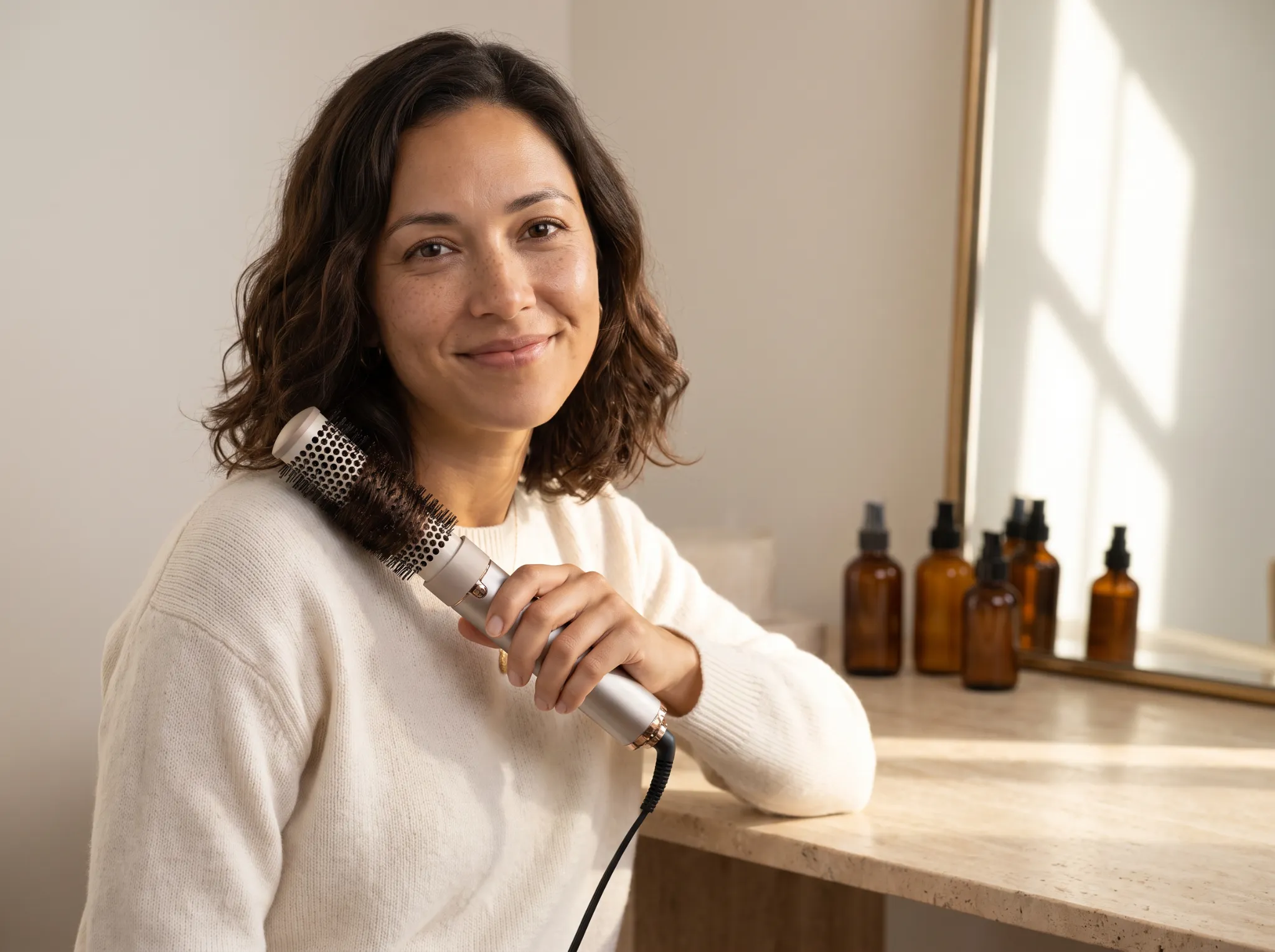
- Barrel Geometry Dictates Shape: Cylindrical barrels apply equal tension for uniform curls. Oval barrels create flat tension for straightening.
- The 80 Percent Pre-Dry Rule: Never style soaking wet hair. Dry your hair to 80 percent first to protect internal cortex protein bonds.
- The Cold-Shot Lock: Blast each finished curl with cool air for 7 to 10 seconds to freeze temporary hydrogen bonds into place.
- Regular Vent Hygiene: Remove shed hair after every use and clean product residue monthly to prevent heat hotspots and motor burnout.
How a Hot Air Curling Brush Works: Round vs Oval Barrel Geometry
A hot air curling brush shapes hair with warm moving air, not with a solid hot plate. The physical shape of the heated barrel decides how tension spreads across each hair strand. A circular hot styling brush keeps a constant radius along its whole circumference. When you wrap a section of damp hair around a round barrel, every hair fiber feels the same curvature and rotational tension. This symmetry lets you create uniform spirals, curtain bang sweeps, and defined curls without creasing your ends.
Oval blowout brushes function on an elliptical geometry with two distinct radii. The broad, flatter face works like a vented paddle brush, providing a wide contact plane that pulls wavy or textured hair straight under convective airflow. The narrow, curved edges generate concentrated lift when you place the tool against your scalp at the hair root. However, this elliptical shape prevents continuous 360-degree rotation. If you try to spin an oval brush through long hair to make curls, the differing radii catch the hair unevenly. This creates tangled knots and irregular, dropped waves.
If you want complete blowout transformations from damp hair, read our guide to the 12 best blow dryer brushes. We break down the top oval and round tools on the market. For a compact tool you can pack in a carry-on, see our travel hair dryer brush guide. If your goal is curling, ringlet formation, or styling short bobs, a dedicated round tool stays the better mechanical choice.
Hair Keratin Science: Hydrogen Bonds, Moisture Thresholds, and the Cold Shot
Understanding how hair responds to thermal airflow prevents heat damage and ensures long-lasting style hold. Human hair fibers consist of roughly 85 percent keratin protein. These proteins form microscopic coiled-coil chains held together by three types of chemical bonds: permanent disulfide bonds, ionic salt linkages, and temporary hydrogen bonds. Disulfide bonds give your hair its permanent texture, whether straight, wavy, or coily. Hydrogen bonds break easily with water and reform as your hair dries.
When you wash your hair, water enters the cuticle layer. It breaks roughly one-third of the hydrogen bonds inside the cortex. This temporary disruption makes damp hair pliable and moldable. However, wet hair is also vulnerable. Saturated hair stretches up to 50 percent before breaking. If you apply high tension to wet hair, you tear the cuticles. This causes permanent fractures in the hair cortex. For this reason, rough-dry your hair with a dryer first. Make sure that it is 80 percent dry before you start your hot air brush styling routine.
Thermal styling tools use convective heat, which is heat transferred through moving warm air, to evaporate remaining moisture while shaping the fiber. Heated airflow between 280 degrees and 320 degrees Fahrenheit (138 to 160 degrees Celsius) softens the keratin matrix above its glass transition temperature. The glass transition temperature is the point where rigid hair proteins turn flexible and take on new shapes. Once the hair wrap molds around the barrel, you must cool the fiber below this temperature threshold to lock the curl in place.
This cooling phase makes the cold-shot setting mandatory. When you hold hair wrapped around the heated barrel for 8 to 10 seconds, activate the cold-shot button for 7 to 10 seconds before unwinding. The sudden drop in air temperature freezes the newly aligned hydrogen bonds instantly. If you drop the warm hair immediately into your hand, gravity stretches the softened keratin bonds and your curl falls flat within an hour.
Engineering & Bristle Anatomy: How Manufacturers Build Styling Brushes
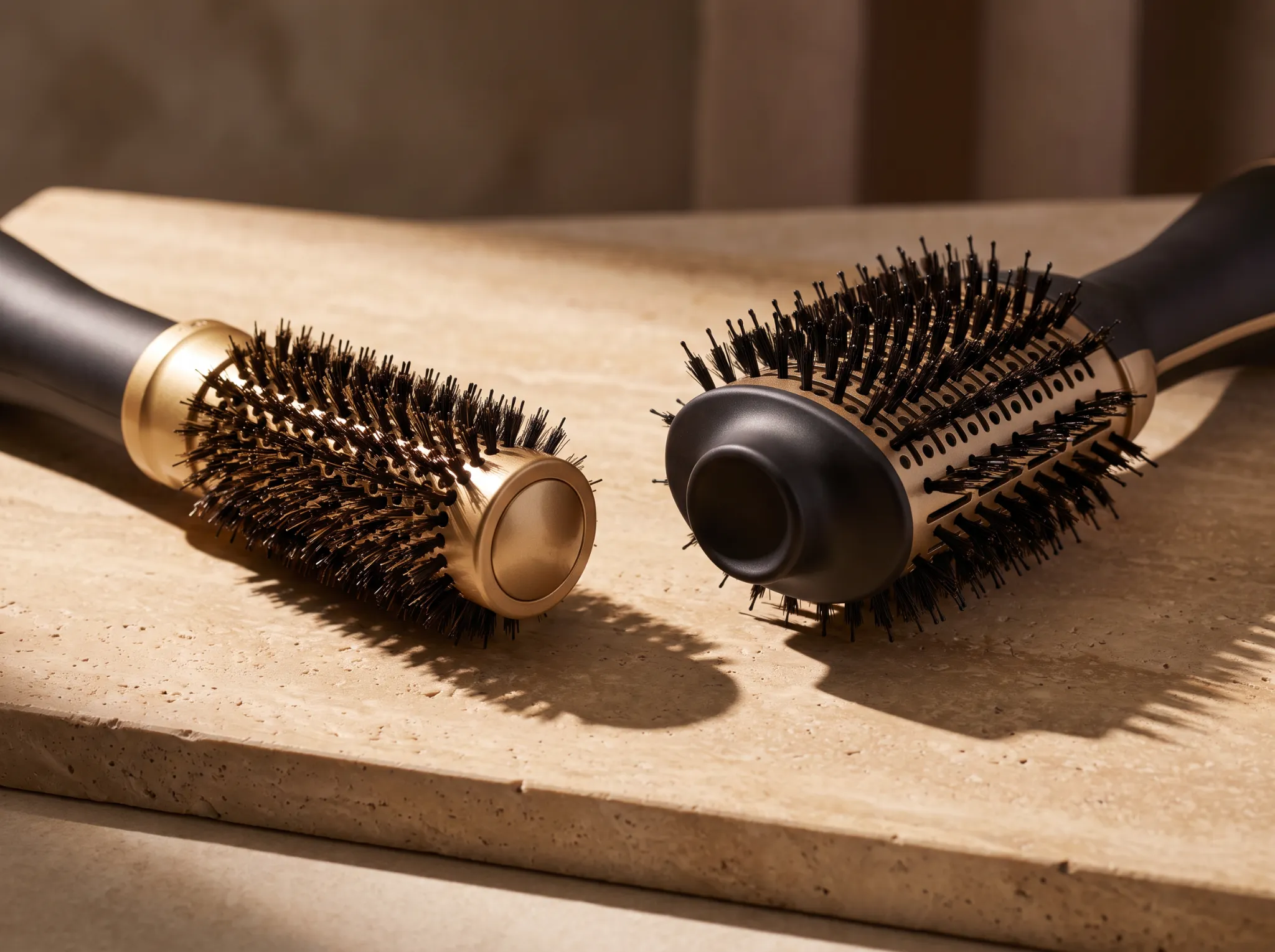
Engineers study how to make a brush for thermal curling and drying. They must balance airflow vents, barrel metals, and bristle pin layouts. The internal barrel must transfer heat uniformly while housing internal air baffles that route motorized airflow through hundreds of perforated exhaust vents.
The surface coating on the barrel controls heat conduction and surface friction. Ceramic coatings provide gentle, even radiant heat. They warm the hair shaft evenly without creating scorching hot spots. Tourmaline, a semi-precious mineral crushed into the ceramic glaze, emits negative ions when heated. These negative ions neutralize static electrical charges along positive hair cuticles, smoothing frizz and sealing the cuticle scales flat. Titanium barrels conduct heat fast and reach higher temperatures. They work well on coarse hair, but you must move them quickly to avoid heat blisters.
Bristle configuration directly dictates how easily your hair slides through the tool. Professional styling brushes use a dual-bristle design:
- Nylon Ball-Tipped Pins: These extended, rigid pins detangle knotted hair sections down to the scalp line. Smooth epoxy ball tips glide across your scalp without scratching your skin. They also create firm tension to guide hair onto the heated cylinder.
- Tufted Boar or Micro-Synthetic Bristles: Shorter, densely packed bristles sit between the nylon pins. These fine fibers grip individual hair strands. They smooth raised cuticles down and distribute natural sebum along the hair shaft to maximize shine.
| Barrel Type | Diameter (Inches / mm) | Primary Styling Purpose | Best Hair Length | Tension Style | Curl Outcome | Pricing |
|---|---|---|---|---|---|---|
| Micro Round | 1.0 in / 25 mm | Fringe, bangs, tight spiral curls | Pixie cuts, chin-length bobs | Rotational grip | Defined ringlets | Check Price → |
| Classic Round | 1.25 to 1.5 in / 32–38 mm | Curtain bangs, bouncy body curls | Collarbone lobs, medium hair | Symmetrical wrap | Bouncy waves & curls | Check Price → |
| Jumbo Round | 2.0 in / 50 mm | Soft polished bends, loose waves | Long hair past shoulders | Gentle roll | Loose Hollywood waves | Check Price → |
| Wide Oval | 2.4 x 2.8 in / 60×70 mm | Smooth blowouts, high root volume | Medium to long, coarse hair | Directional pull | Straight with curved ends | Check Price → |
Step-by-Step Styling Protocol: How to Use a Curling Brush Correctly
Every hot air curling brush uses the same core motion. Learning how to use curling brush attachments well takes a clear sectioning plan and careful timing. Follow this five-stage protocol for long-lasting curl definition with less heat exposure:
Stage 1: Prep and Thermal Protection
Wash your hair with a gentle, sulfate-free shampoo and rinse thoroughly. Towel-dry gently by squeezing with a microfiber towel. Never rub hair aggressively, because friction roughs up cuticle scales. Apply a lightweight leave-in heat protectant with silicones like dimethicone. These ingredients form a shield that slows heat transfer into the hair cortex. Rough-dry until your hair is 80 percent dry.
Color-treated and lightened hair needs a lower setting than virgin hair. Bleach lifts the cuticle permanently, so heat reaches the cortex far faster. If you lighten your hair, review our guide to blonde hair care products before your next curling session.
Stage 2: Precision Sectioning
Divide your hair into four clean quadrants: two sections in front of the ears and two in the back. Secure each section with salon crocodile clips. Work in small subsections no wider than the barrel of your brush and no thicker than one inch. If your subsection is too thick, the inner hair remains damp while the outer layer overheats.
Stage 3: Symmetrical Tension Wrapping
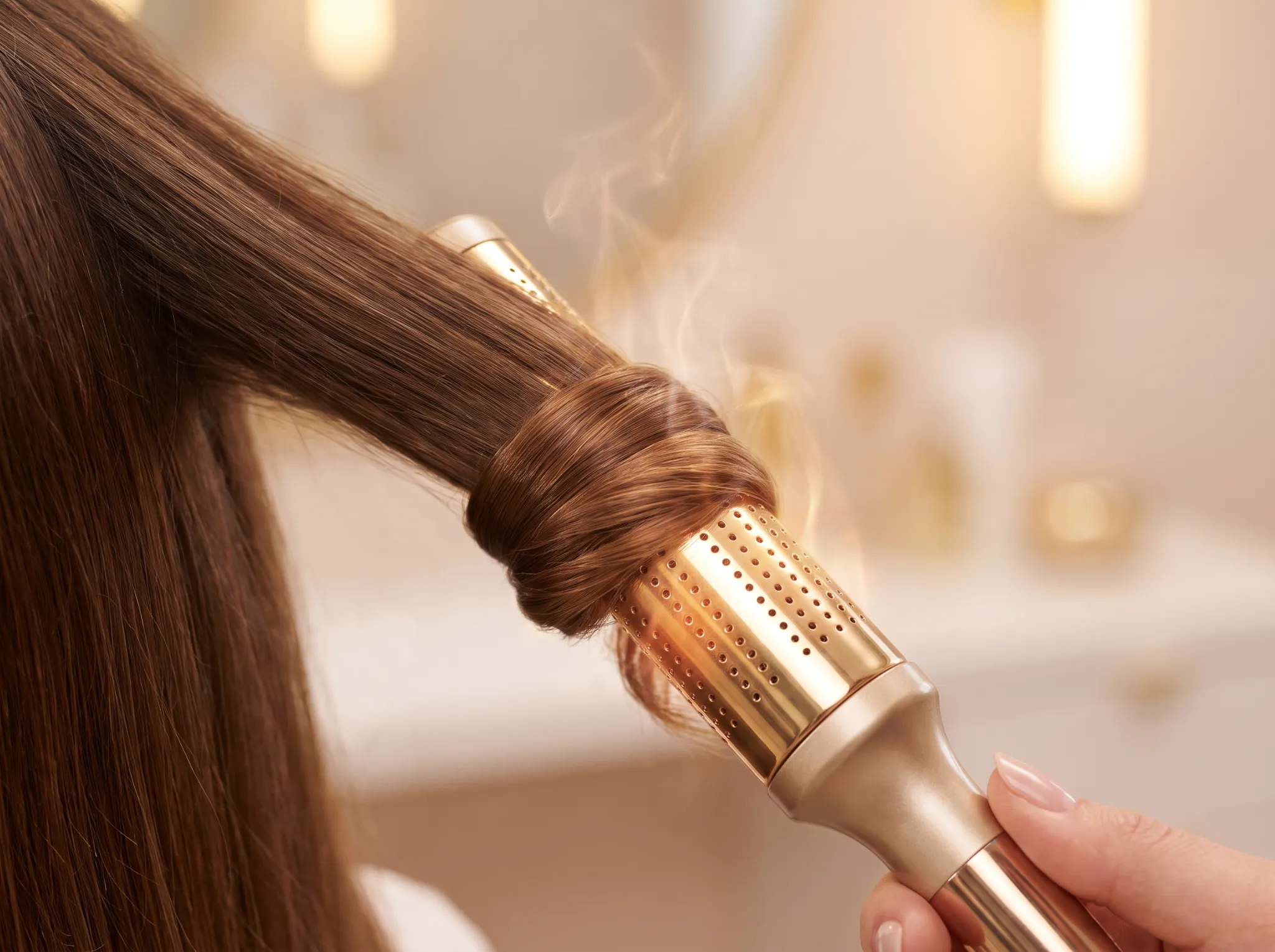
Place the heated barrel at the mid-lengths of your hair section. Smooth down to the ends first to align the cuticle. Once the ends catch the bristles, rotate the brush inward or outward toward your scalp. Maintain steady, gentle tension as the hair wraps around the cylinder. Keep the barrel moving slightly to ensure even airflow distribution through the vents.
Stage 4: Thermal Dwell and Cool-Shot Freezing
Hold the hair wrapped securely against the warm barrel for 8 to 10 seconds. You must avoid keeping heat on the hair for longer than 15 seconds to prevent moisture loss. While the hair remains wrapped on the barrel, press and hold the cold-shot button for 7 to 10 seconds. Listen for the motor tone shift as the heater cuts out and ambient air chills the keratin fibers.
Stage 5: Friction-Free Release
Do not pull the brush downward through the curl. Instead, gently unwind the barrel in the opposite direction of the wrap, letting the coiled curl drop into the palm of your hand. Cup the warm curl in your hand for three seconds to allow final cooling before letting it hang. Repeat this process across all quadrants, always curling away from your face for a modern, open aesthetic.
Tool Hygiene & Maintenance: How to Clean Heated Barrels and Natural Brushes
Over several weeks of styling, shed hair and sebum gather around your bristles. Styling sprays also collect on the air vents. When heated, these baked-on residues insulate the barrel surface. This causes uneven heating and singed hair odors. Clogged air intake filters also strain the motor, causing premature electrical failure.
To clean an electric hot air brush safely, first unplug the tool and allow it to cool completely. Take a metal rat-tail comb or a wire bristle rake. Gently lift tangled shed hair out from the base of the bristles. Cut stubborn hair fibers with small scissors, taking care not to snip the nylon pins. Dampen a microfiber cloth with warm water and clarifying shampoo, or use 70 percent isopropyl alcohol. Wipe down the ceramic barrel between the bristle rows to remove styling residues. Never immerse an electric styling tool in water or rinse it under a running faucet.
The care routine for heated electrical tools differs a lot from heritage manual brushes. If you own a manual boar-bristle brush, learning how to clean a mason pearson brush protects its natural materials. A Mason Pearson brush has an untreated natural rubber pad and pure boar bristles. Hot water, harsh soaps, and alcohol dry out and crack the natural rubber. Instead, use the nylon cleaning brush from the manufacturer to brush lint and dust away. If washing is necessary, dip only the bristles into cool soapy water. Keep the breathing hole at the top of the pad dry, and shake out water right away.
Scalp Ergonomics & Recovery: Relieving Styling Tension with Gua Sha
Many people experience mild scalp soreness or tenderness after an intensive round-brush blowout session. This discomfort happens because the tension pulling hair against a barrel strains the hair follicle root. The hair shaft has no nerves. However, each follicle root sits inside a nerve-rich sheath surrounded by the arrector pili muscle. If you pull hair against its natural growth angle, these nerve endings become irritated and tender.
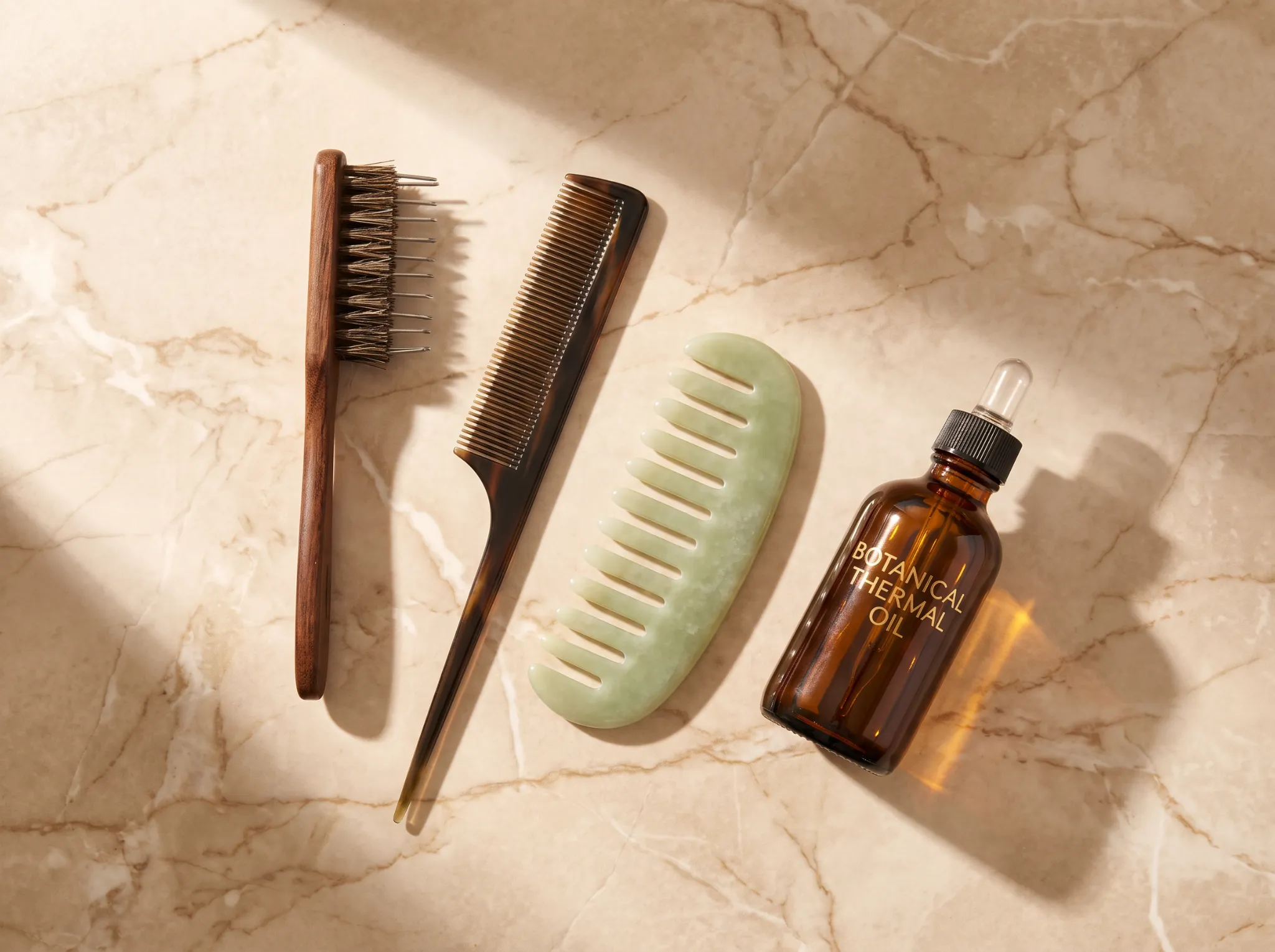
To relieve this post-blowout tenderness, incorporate a smooth stone comb gua sha into your evening hair routine. A comb gua sha uses polished jade, rose quartz, or bian stone. It features rounded, wide-spaced teeth that glide smoothly across the scalp without snagging your style. Start at the hairline and sweep the stone comb backward toward the crown. Use slow, rhythmic strokes with light pressure. Continue down the back of your head across the occipital bone at the skull base.
This gentle mechanical stimulation promotes microcirculation around the capillary beds supplying your hair follicles. It drains stagnant lymphatic fluid and relaxes tight pericranial muscles strained during styling. Two minutes of scalp gua sha restores comfort to sensitive roots. It also supports healthy scalp skin for ongoing hair growth.
Frequently Asked Questions
To clean non-electric combs and brushes, remove all trapped hair using a tail comb or bristle rake. Fill a bowl with warm water and mix in one tablespoon of clarifying shampoo and one teaspoon of baking soda to dissolve oily sebum. Soak plastic combs and synthetic brushes for 15 minutes. Scrub between the bristles with a clean toothbrush, and rinse with warm tap water. Lay them face down on a clean towel to dry. If your brush has an electric cord or motor, never put it in water. Instead, wipe the unplugged barrel with a damp cloth.
You clean combs and brushes by following a two-step method that separates dry debris removal from sanitary washing. First, remove shed hair and lint with a wire brush cleaner or a comb tail. Second, soak plastic combs and manual brushes in warm soapy water for ten minutes. Use an old soft toothbrush to scrub away white cosmetic residue along the bristle bases. Rinse the tools in lukewarm water. Let them air-dry completely on a clean towel before you style your hair again.
You style hair by preparing clean, damp fibers with a heat protectant spray and pre-drying the hair until it is roughly 80 percent dry. Divide your hair into four manageable quadrants using sectioning clips. Select a tool suited to your goal. Use a round hot air curling brush for curls and curtain bangs, or use an oval brush for smooth blowouts. Work in small subsections and wrap the hair smoothly around the tool. Apply steady heat for eight to ten seconds, and lock the shape with cool air before you release it.
The right hair style depends on your facial bone structure, hair density, and daily maintenance routine. A round hot air brush creates versatile styles including bouncy 90s-style blowouts, flicked curtain bangs, curled-under bob perimeters, and soft spiral waves. If you want low-maintenance styling with root fullness, a sleek blowout with an oval tool provides polished everyday wear. Match your barrel size to your goal. Choose smaller 1.0-inch barrels for defined curls and larger 2.0-inch barrels for relaxed body waves.
Hair is a biological fiber composed of dead, keratinized protein cells that grow out of follicles located in the dermal layer of your skin. Each hair strand has three layers: the outer protective cuticle, the middle cortex that provides strength and color, and the central medulla. The visible hair shaft contains no living cells, blood vessels, or nerve endings. As a result, maintaining hair softness, elasticity, and shine requires external care, hydration, and careful temperature control during heated styling.
Your hair shaft cannot feel pain, but your scalp and follicle roots are highly sensitive. When your hair feels sore, you feel perifollicular nerve inflammation. Doctors call this condition trichodynia. This discomfort comes from mechanical pulling during blowout styling, high heat near the scalp, or tight ponytails. The pulling forces strain the tiny arrector pili muscles and nerve networks surrounding each follicle. Gentle scalp massage with a stone comb gua sha helps relax these muscles and alleviate soreness.
- Robbins, C. R. (2012). Chemical and Physical Behavior of Human Hair (5th ed.). Springer Science & Business Media. DOI: 10.1007/978-3-642-25611-0.
- Lee, Y., Kim, Y. D., Hyun, H. J., Pi, L. Q., Jin, X., & Lee, W. S. (2011). Hair shaft damage from heat and drying time of hair dryer. Annals of Dermatology, 23(4), 455–462. DOI: 10.5021/ad.2011.23.4.455.
- Gavazzoni Dias, M. F. (2015). Hair cosmetics: An overview. International Journal of Trichology, 7(1), 2–15. DOI: 10.4103/0974-7753.153450.
- Swift, J. A. (1999). The mechanics of human hair: A review. International Journal of Cosmetic Science, 21(4), 227–239. DOI: 10.1046/j.1467-2494.1999.196564.x.
- Trueb, R. M. (2009). Oxidative stress in ageing of hair. International Journal of Trichology, 1(1), 6–14. DOI: 10.4103/0974-7753.51923.