

- Your iris color decides the shade family. Brown eyes take a cool flank best – navy, plum or blue-violet lashes separate the lash line from the iris.
- Formula family matters more than shade. Tubing wraps each lash in a polymer tube; fibre stacks physical fibres; waterproof bakes a hard film; washable is the softest.
- Tubing mascara removes with warm water and gentle pressure. Water alone or rubbing alone will not move it.
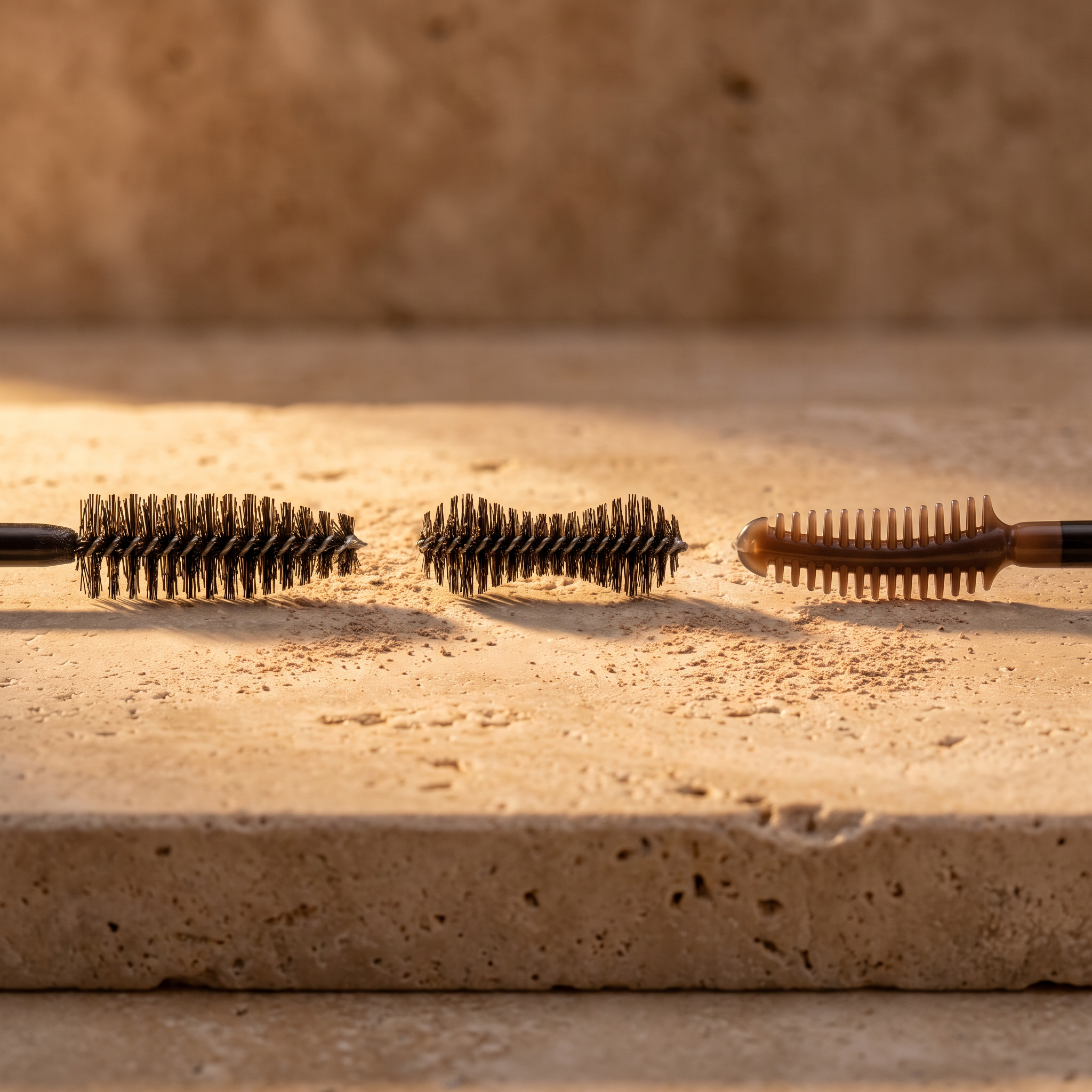
- Wand shape sets the finish. Tapered separates, hourglass curls, curved lifts straight lashes, spiral builds volume.
- Long-term daily wear is linked to lash loss. Remove gently, never rub, and take rest days.
Why Color Reads Differently on Brown Eyes
Brown is a warm iris color with mid-to-high chroma, which means the color is fairly saturated. A cool lash tone sits opposite it on the color wheel. That contrast makes the iris look clearer, because the lash line and the iris stop reading as one block of tone.
This is a color rule, not a taste opinion. Complementary pairs on the wheel cancel each other, and a corrective pigment measurably shifts the hue and lightness of the surface it sits on. A 2025 study in the Journal of Cosmetic Dermatology tested six colored primers on 16 volunteers and measured the result with the VISIA-CR imaging system. Every primer significantly shifted ITA, the pigmentation angle, across four facial regions. Purple and blue most reduced yellowness, and pink most neutralised a bluish cast. A two-way analysis of variance found a significant main effect for color on yellowness, ITA and hue angle.
Read the boundary of that study carefully. It tested skin primers, not iris color, and no trial has measured mascara color against iris color. So the honest version of the claim is this. Complementary correction demonstrably shifts hue, and the same physics applies when the warm brown disc sits beside a cool lash line. What you get is separation and contrast, not a change in your eye color.
That is why a cool flank is the reliable choice. Navy, plum and blue-violet raise the perceived gap between the lash line and the iris. A warm lash tone collapses that gap, because warm against warm is the same note played twice. The shade section below sets out the full range, and the exceptions for warm hair tones.
Brown is already a warm hue. A warm lash color such as red-brown or copper muddies it. Navy, plum and blue-violet sit opposite brown and lift the iris instead.
The Four Formula Families
Formula family decides three things at once. How the lash looks, how long it lasts, and how it comes off. The shade is the easy part. Here are the four families and what each one does.
Tubing mascara: the polymer tube that warm water unlocks
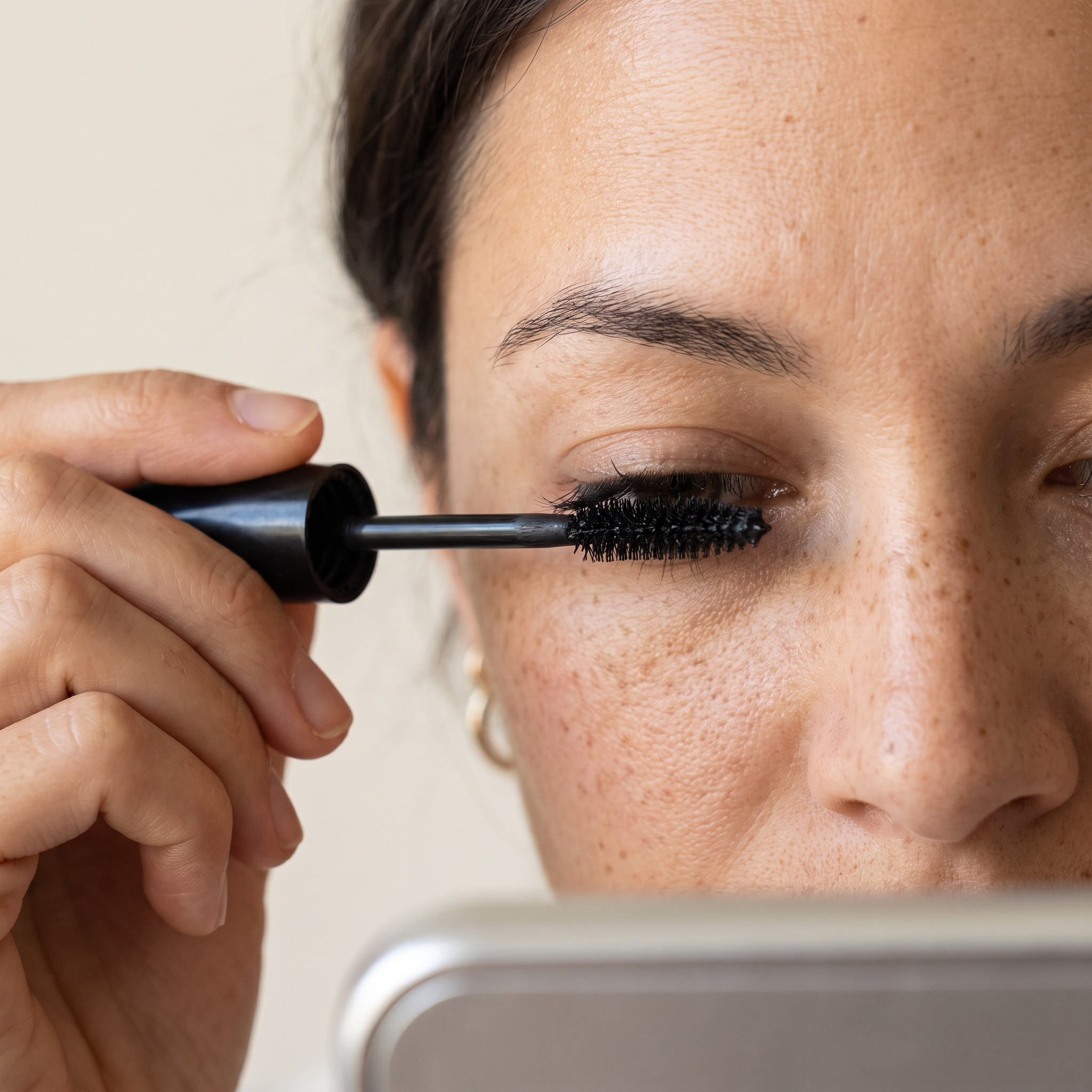
Tubing mascara is a water-based formula built on an acrylic copolymer. You apply it wet, and as the water evaporates the polymer sets into a solid tube that physically wraps each lash. That tube is water-resistant. Sweat and tears do not supply enough water to break it, and rubbing cannot shift it. Warm water plus gentle pressure swells and releases the tube, which then slides off intact. Neither half of that works alone, and a standard makeup remover will not dissolve the film.
Newer film technology goes further and makes water resistance and easy rinsing coexist. A hydrophobic film alone resists water but also resists rinsing. Adding an amphiphilic polymer, a molecule with affinity for both water and oil, creates hydrophilic domains inside the hydrophobic film. That polymer acts as a temperature-responsive trigger. In warm water it destroys the film from within. Shiseido researchers described exactly this system in the Journal of the Society of Cosmetic Chemists Japan. That paper turns “warm water removes it” from a marketing line into a documented polymer mechanism.
Fibre mascara: length built from the wand
Fibre mascara suspends small synthetic or plant-derived fibres in the formula, usually nylon, rayon, silk or cellulose. They cling to the wet film and stack on top of each other. Deposited material, not the lash itself, extends the visible tip of the lash. The effect is temporary and leaves with the film.
No peer-reviewed trial has measured how much length fibre mascara adds. Treat the mechanism as standard cosmetic chemistry and treat any percentage on a package as unverified. A cosmetic mascara cannot lengthen lashes long-term. The only agent approved for lash growth is bimatoprost 0.03 percent, and that is a prescription glaucoma medicine, not a cosmetic.
Waterproof mascara: the hardest film to remove
Waterproof mascara replaces the water-soluble film formers with water-repellent polymers that set into a hard, non-porous film. It will survive swimming and tears. It will also resist the removal method your lashes tolerate best, and that trade-off matters.
A cross-sectional study in the International Journal of Trichology covered 128 medical students. It found eyelash loss in 19 percent of them. Eye problems such as redness and itching appeared in 31 percent. Years of use was significantly higher in the group who lost lashes, at 5.17 against 3.19 years. Itching before the lash fall was present in every subject who lost lashes, which points to an irritant or inflammatory pathway. Water alone for removing waterproof mascara carried the highest rate of lash fall in that study. Vigorous rubbing is the mechanical second cause, so the lesson is not to scrub harder. Reach for an oil cleanser and let it dissolve the film before you touch the lashes.
One more caveat applies to color in particular. Film hardness is tunable, and adding pigment tends to reduce it. Research from Coty published in the International Journal of Cosmetic Science screened acrylics, polyurethanes and a pyrrolidone under heat, surfactant and pigment load. A styrene-acrylate softened by 30 percent after heating, and most polymers lost hardness once pigment was added. That is why a colored version of a base formula can flake or droop where the black version holds.
Washable and clean formulas: a lower dye and preservative load
Washable mascara uses ordinary water-soluble film formers, so warm water and a cleanser take it off without pressure. Its weakness is wear. It smudges more readily under heat and humidity, and it will not survive tears.
“Clean” on a mascara label usually means a shorter preservative and dye list. Be precise about what that buys you. Preservatives such as benzalkonium chloride are potentially toxic to the cells on the surface of the eye. Mascara is a preserved water-based product, and you apply it right beside the tear film. A lower preservative and dye load is gentler for sensitive eyes and for contact lens wearers. It is not clinically safer, and it does not make an unreacted product safe. Replace mascara on the schedule the maker states, because a contaminated tube is the real risk.
Wand Geometry: Choosing the Shape That Earns Your Finish
The brush is doing more work than the formula for most people. Geometry decides how much product reaches the lash, where it sits on the lash, and whether the lashes stay separated as the film sets.
Tapered. A narrow tip and a wider base. The taper reaches the short inner lashes without overloading them, and it separates as it draws through. This shape suits readers who want definition rather than density.
Hourglass. A pinched waist that holds a reservoir of product and flares at both ends. The waist loads volume in a single pass, and the flare fans the outer lashes. It is the volume shape, and it rewards a light hand because it deposits a lot.
Curved. The brush bends to match the lash line, so the bristles meet straight lashes along their length rather than only at the root. That is the lift shape. It is the right pick if your lashes grow straight out or downward and drop their curl within an hour.
Spiral. Helical bristles twisted around a wire core. It grabs and loads fast, so it builds density quickly and separates less. Expect a fuller, less defined lash, and expect to need a clean pass with a second tool.
Comb or hybrid. A silicone comb defines and separates after the product is on. A hybrid pairs a bristle side for volume with a comb side for length and curl. That two-sided format does two jobs in one pass, which is genuinely useful if you want volume at the base and definition at the tips.
Wand choice also interacts with lash type. Straight lashes need a shape that scoops the lash upward, and that is usually curved or hourglass. Fine or sparse lashes need separation more than density, so a tapered or comb wand gives a cleaner result than a heavy spiral. If your curl drops through the day, try an eyelash primer. Apply it before the mascara, because the primer changes how the film adheres to the lash. It can also help the curl hold better.
Tapered wand separates and lengthens. Hourglass curls and volumizes. Curved wand lifts straight lashes. Spiral brush loads volume fast. Comb wand defines after you build.
Matching the Shade to Your Iris and Hair Tone
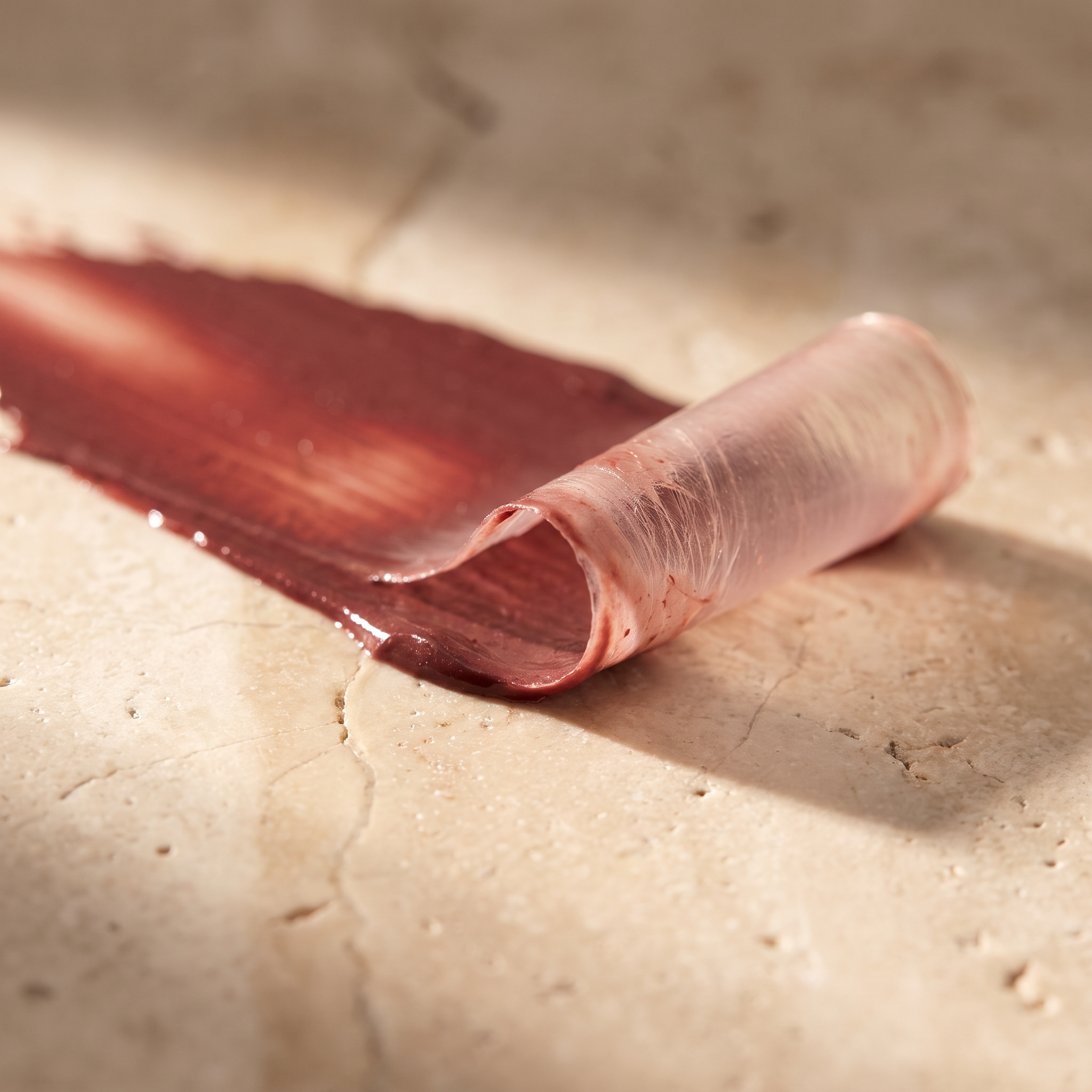
Here is the working palette, and the reason each shade sits where it does.
Navy. The safest cool choice and the easiest to wear daily. It is dark enough to read almost like black at a distance. But the blue cast separates the lash line from a brown iris without announcing itself. Start here if you have never worn a colored mascara.
Blue-violet. A stronger version of the same idea. It sits closer to the purple end of the opposite flank, so the contrast is more visible in daylight. It suits a reader who wants the color to be noticed.
Plum. A deep purple with red in it. Plum flatters a brown iris with red or warm brown glints because it echoes the warmth while staying on the cool side of the wheel. It is the most forgiving cool shade on a warm hair tone.
Burgundy. A deep red-purple with real depth. It is the boldest option in this set and the one that reads most clearly as a color choice rather than as a near-black. It pairs well with a warm brown iris.
Brown. The neutral. Dark brown mascara is the “my lashes but better” option, and it is noticeably softer against the skin than a black film. On a fair reader with light brown eyes it can look more natural than black.
Forest green. A deliberate exception rather than a rule. Green is not opposite brown, so it does not separate a brown iris the way navy does. It works on a hazel-brown eye with green flecks, where it pulls the flecks forward.
The coverage rule is that the color should flatter the iris, not compete with it. A shade too close to your eye color flattens the whole area. The hair-tone exception matters here. If you are a warm blonde or a redhead, a cool navy can look disconnected from your coloring. Plum or burgundy carries the same contrast with more warmth underneath, so it sits better on the face.
Tone coordination extends past the eye. A clean, even under-eye keeps the focus on the lash rather than on the shadow beneath it. Our guide to concealer for dark circles shows how that correction works. If you want the base to carry the same logic, the undertone rules in our guide to luxury makeup foundations apply here too. If you wear colored mascara on the lash line, match your liner to the lash tone rather than the iris. That holds the look together. Our liquid eyeliner guide sets out the principle.
Wear, Removal and Lash Health
Removal is where the damage happens, and each family needs its own method.
Tubing. Soak the lashes with plenty of warm water, then apply light pressure and let the tubes slide off. Water alone will not release them, and pressure alone will not either. The combination is the mechanism. Do not pull at a tube that has not released, because you will take the lash with it.
Waterproof. Use an oil cleanser and let it sit long enough to break the film down, then wipe with the grain of the lash. Rubbing a hard film is the failure mode. This is the family where a hurried removal costs you lashes.
Washable and tubing. Warm water and a cleanser are enough. No pressure, no friction, no dedicated remover needed.
Two habits do most of the work in protecting lashes. First, never sleep in mascara. The product sits on the lash margin for hours as a chemical and physical irritant. The eyelid presses it against the lash line all night. Second, take rest days. Duration of use was the dominant factor in the lash-loss study, so an occasional bare-lash day is a real intervention rather than a beauty cliche.
Contact lens wearers have one extra step that is not optional. A study in the Journal of Biomaterials Applications tracked mascara deposits with aluminum as a marker element. The deposits adsorbed onto worn silicone-hydrogel lenses as firmly bound aggregates. Saline does not rinse them off, and the deposits were more strongly bound than components of tears. The two lens materials tested differed too, with one showing more than twice the affinity of the other. The authors note that they could not determine adverse-reaction effects from this work, so read the finding narrowly. Take your lenses out before you remove eye makeup, and store them clean.
If your lashes are fine or thinning, choose a lighter tubing formula and skip the heavy volume films. A lighter tube puts less weight on the lash and needs less work to remove, which is the two things a fragile lash cannot absorb.
Vigorous rubbing during removal is a mechanical cause of lash loss. For tubing formulas, soak with warm water and let the tubes slide off. For waterproof films, use an oil cleanser and let it dissolve the film first. Contact lens wearers: take lenses out before removing eye makeup, because mascara deposits adsorb onto silicone-hydrogel lenses and will not rinse away with saline.
Choosing by Lash Type and by Age
Lash type changes what a formula can do for you, and the change is more pronounced over 50.
Fine or sparse lashes. Weight is the enemy. A heavy volume film drags a fine lash down and clumps it at the base, so the finished lash reads shorter than a bare one. A light tubing formula that coats each lash individually adds definition without load. This is where the volume extreme works against you.
Thinning lashes. The same logic applies with more force, and a pigmented color has an advantage here. A navy or plum film adds visible presence at the lash line, so a thinner lash still reads as a deliberate lash line. A black film on a thinning lash reads as gaps, because black is the highest contrast against skin.
Mature lashes. Curl drop becomes the main complaint. Lashes that once held a curl flatten through the day, and a heavy formula speeds that up. A lighter tubing formula often beats a heavy volume formula here, because the finished film weighs less. If curl is the priority, pair it with a curved or hourglass wand, and consider an eyelash primer underneath to improve how the film holds.
Hooded or drooping lids. An hourglass wand that fans the outer lashes gives the eye more visible lash area than a straight brush. The lash line is the part the lid does not cover, so put the volume there.
Short lashes. Fibre adds temporary length by stacking material on the tip, which is the honest version of what it does. Combine a fibre formula with a tapered or comb wand and you get length plus separation. Do not expect the lash itself to grow.
One habit ties all of these cases together. Whatever your lash type, remove the product gently and give the lashes rest days. No formula compensates for lashes pulled out at the root. No colored film looks good on a lash line that thinned from rough removals.
Mascara for mature women is mostly a curl question, because curl drop is the usual complaint. If you are over 50 and your lashes have fallen, choose the formula that holds a curl before you choose the volume claim. None of these need a prescription. Every pick is an over the counter buy, so the same test works on any tube you can hold.
The Verified Edit
blinc UltraVolume Tubing Mascara, Volumizing & Lengthening, Dark Brown
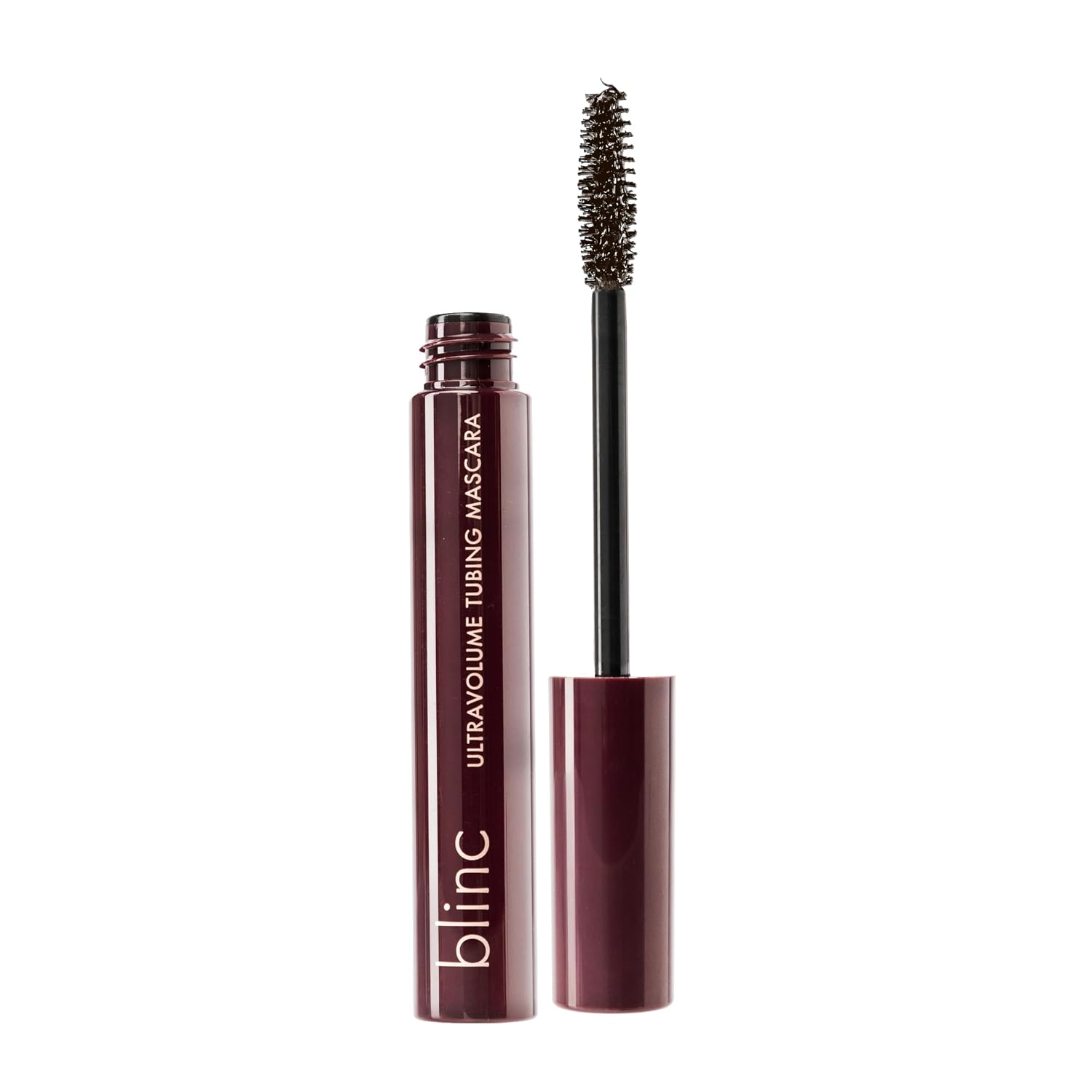
The volume extreme of the technology this article is built on. Polymer tubes wrap each lash for maximum volume without running or flaking, and unlike the Original they keep taking coats through the day.
Avery, Beautyisles AI Editorial Host
- Tubing film resists smudging, flaking and running
- Builds in layers through the day, unlike Original
- Removes with warm water and no rubbing
- Heavier tube looks less natural on fine lashes
- Deep neutral brown, so a wear pick not a color pick
Whats Up Beauty Watch Me! Colored Mascara, Burgundy
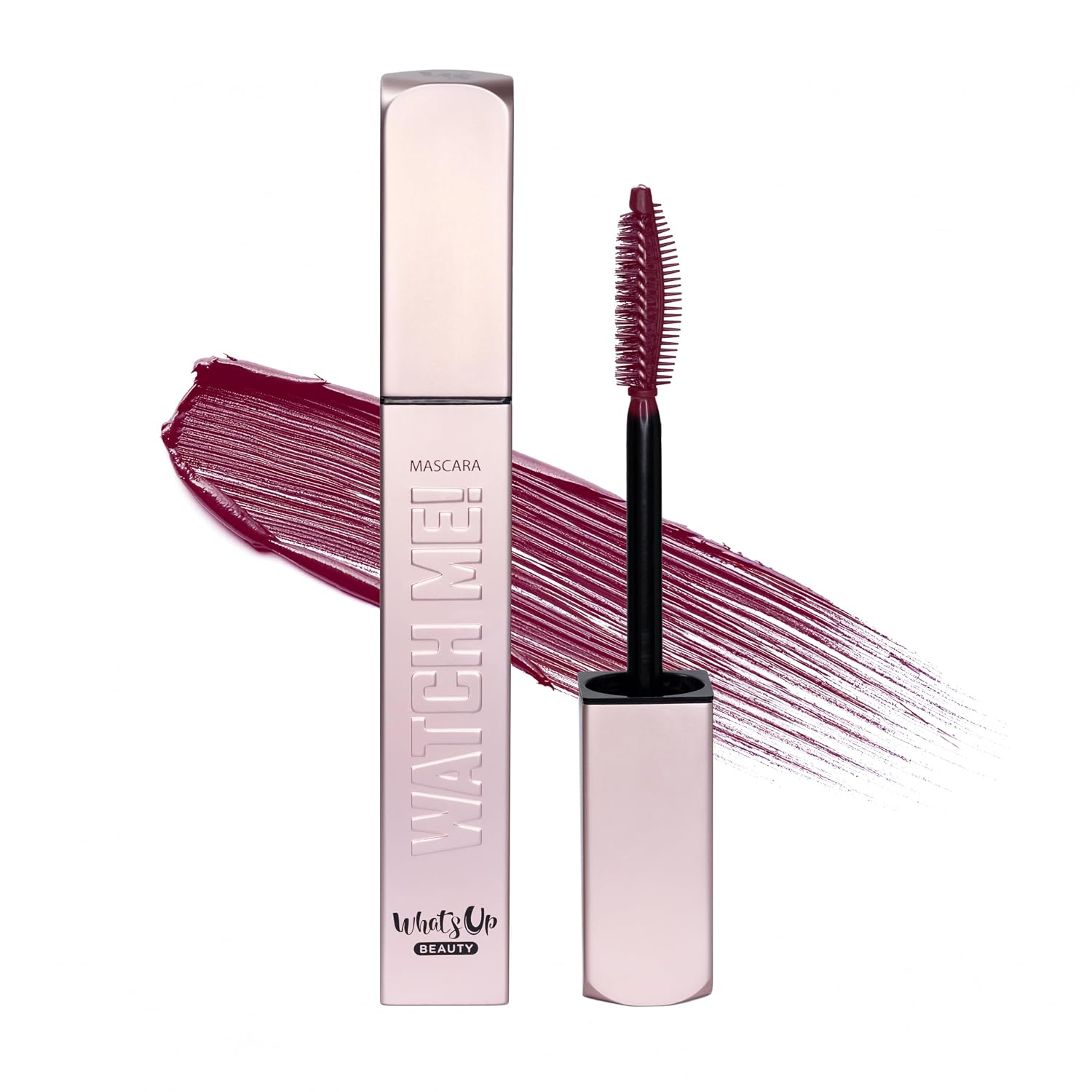
The true color pick, on the cool-purple flank this article’s shade rule calls for. A wire-bristle side builds volume and a silicone comb defines each lash, for a flake-free matte that holds length.
Avery, Beautyisles AI Editorial Host
- Dual wand: wire bristles volume, silicone comb definition
- Flake-free matte film holds lash length
- Mineral iron oxide pigment with panthenol and a peptide
- Not water resistant, so it will not survive swimming
- Carmine and beeswax, so cruelty-free but not vegan
blinc Original Tubing Mascara, Natural Look & Lengthening, Dark Brown
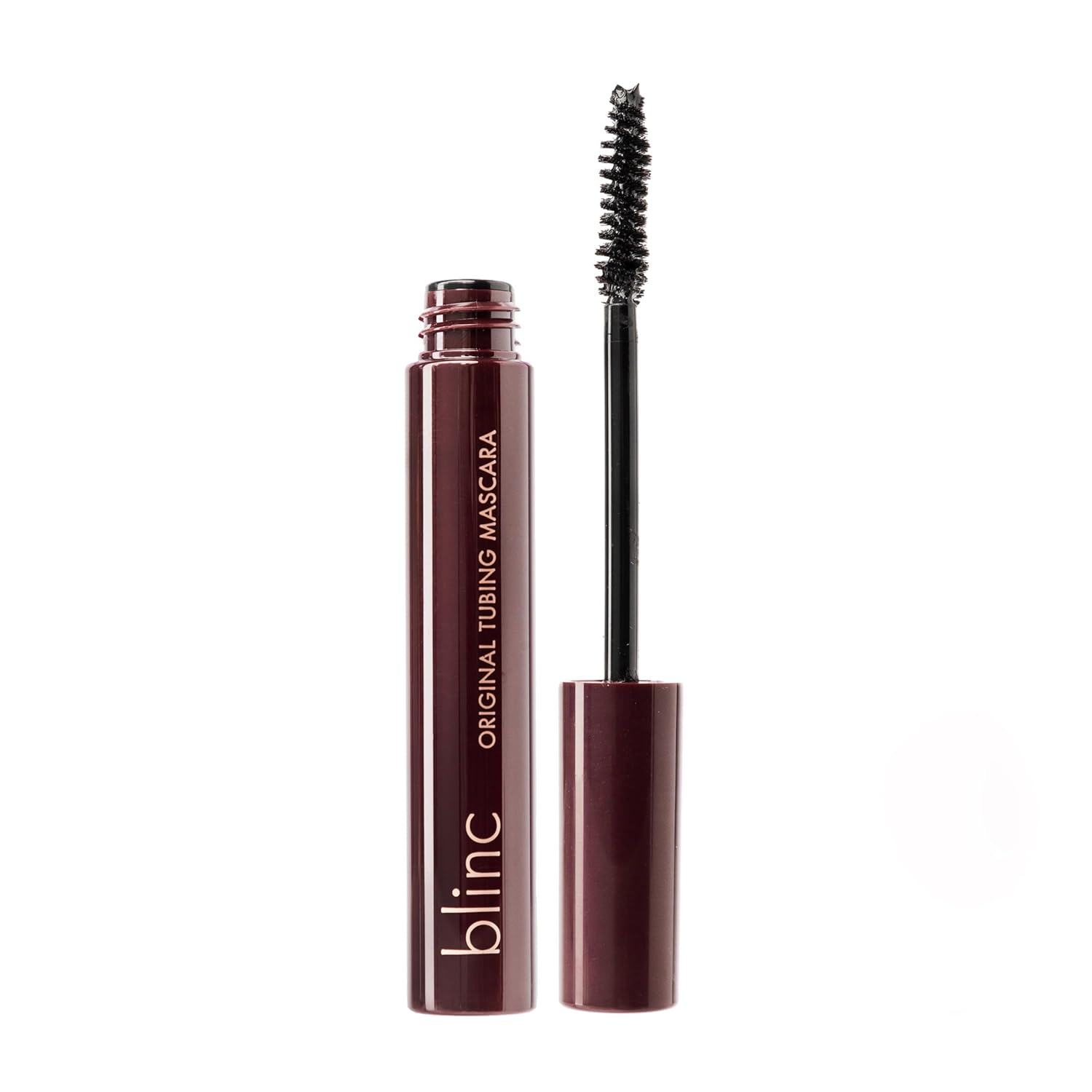
The literal polymer tube this article explains. It resists smudging, clumping and flaking through sweat and tears, removes with warm water alone, and is formulated for sensitive eyes and contact wearers.
Avery, Beautyisles AI Editorial Host
- Single-layer tubing film resists sweat and rubbing
- Removes with warm water and gentle pressure
- Formulated for sensitive eyes and contact lens wearers
- Sets in 60-90 seconds, so no later coats
- Tint-like finish is subtle next to a volumising tube
Thrive Causemetics Liquid Lash Extensions Mascara, Brynn (Rich Black), Bestsellers Shade Set
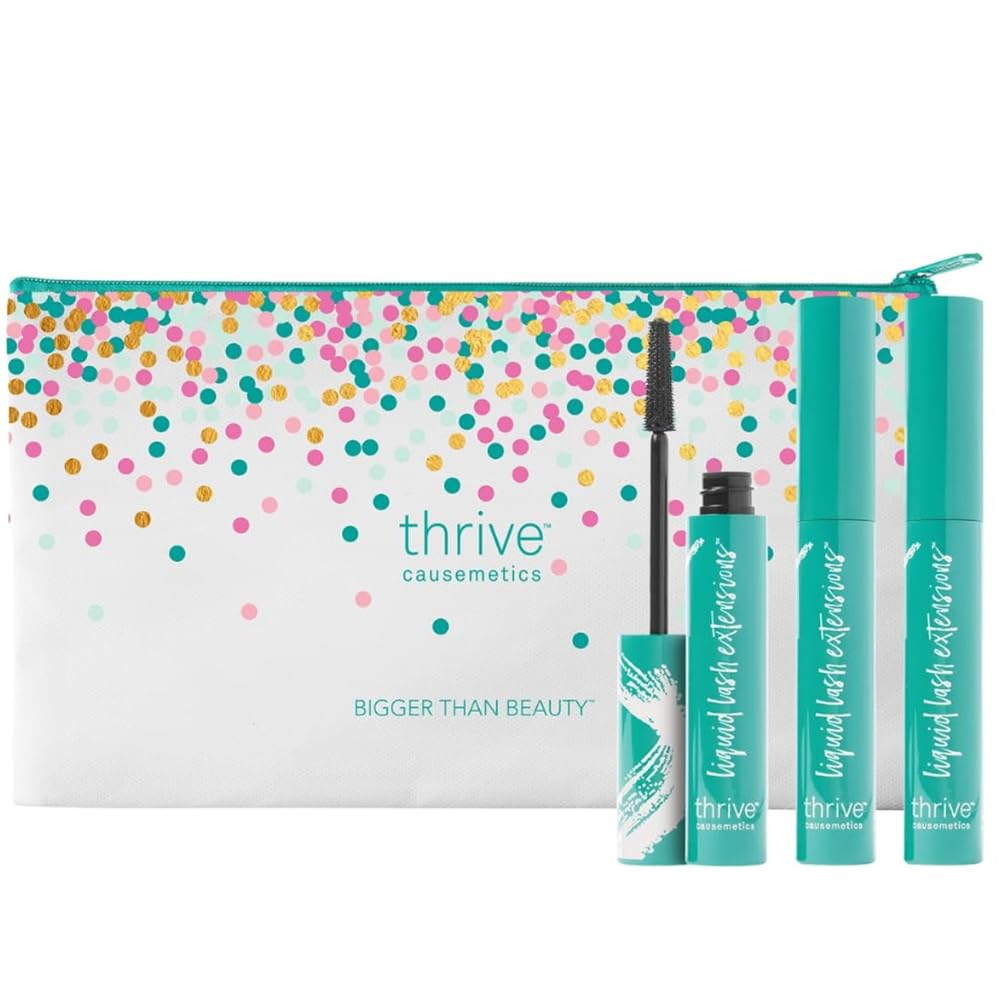
The prestige tubing benchmark, sold as a shade set rather than a single tube. It builds and extends each lash without clumping and stays smudge-proof, while water-resistance keeps removal gentle.
Avery, Beautyisles AI Editorial Host
- Tubing formula extends lashes without clumping
- Smudge-proof and transfer-proof through a long day
- Straight wand fans and separates as it draws
- Shade set gives more product than a single-tube trial needs
- Black shade family, so a length pick not a color pick
Every pick in this edit sits above drugstore pricing. If you want the best drugstore mascara, apply the same two tests. How does the film come off, and how does the color read against a brown iris?
Frequently Asked Questions
These are the questions readers ask most about colored mascara for brown eyes. Each answer opens with the direct point, then gives the reason.
What is tubing mascara?
Tubing mascara is a water-based formula built on an acrylic copolymer that sets into a solid polymer tube around each lash. The tube is water-resistant, so sweat and tears do not move it. Warm water plus gentle pressure swells and releases it, and the tube then slides off intact. It is covered in more detail in the formula section above.
What is the best mascara for brown eyes?
For brown eyes, choose a cool tone in a formula you can remove cleanly. Navy, plum and blue-violet sit opposite brown on the color wheel, so they raise the contrast between the lash line and the iris. A warm lash color such as red-brown or copper muddies the same iris instead of lifting it. Check the wand last, because it sets the finish rather than the color.
Is it bad to sleep with mascara on?
Yes, and the reason is duration. A study of 128 mascara users found eyelash loss in 19 percent of them. Years of use was significantly higher in the group who lost lashes. Itching before the lash fall appeared in every subject who lost lashes. Sleeping in it keeps the product against the lash margin for hours.
How do you fix dry mascara?
Add one or two drops of saline or an eye-safe lubricant to the tube and roll it between your palms, never pump the wand. Pumping pushes air in and dries the formula faster. If the tube smells different or the texture feels gritty, replace it rather than revive it. That is because a preserved water-based product can carry contamination.
What color mascara for green eyes?
Green eyes take the opposite treatment from brown, and plum or burgundy does the work. Red-purple sits on the flank that separates a green iris, and it raises contrast in the same way navy raises it for brown eyes. A warm brown mascara is the soft neutral option on a green or hazel eye.
What is a good mascara for length and volume?
A tubing formula with a hybrid or hourglass wand covers both. The tubing film builds and extends each lash without clumping, and the wand geometry fans the lashes so the length is visible. Fibre adds temporary length by stacking material on the tip, but no peer-reviewed trial has measured how much it adds.
What is the best mascara?
There is no single best mascara, because the answer depends on your lash type and your removal habits. A tubing formula suits most readers, since it holds through the day and releases with warm water and gentle pressure rather than rubbing. If you want color on brown eyes, a navy or plum tubing formula covers both goals at once.
Do you put mascara on false eyelashes?
You can, and one thin coat helps blend the false lash with your own lashes at the band. Apply it after the adhesive has fully set, and use a light hand. Avoid waterproof formulas on strip lashes, because the harder film needs more pressure to remove and that pressure works against the adhesive edge.
Is mascara makeup?
Yes. Mascara is a cosmetic, which is the category of product applied to change appearance rather than to treat a condition. That classification has a practical consequence. Cosmetics are not required to run clinical trials. That is why much of the evidence about mascara is about film chemistry, wear and removal rather than claimed benefits.
When was mascara invented?
Colored lash and brow pigment is ancient, and early forms used kohl, charcoal and plant-derived color. The tube-and-wand mascara you would recognize today is a modern cosmetic-industry development. The relevant point for a modern reader is the film technology rather than the history. That is because the polymers in the tube now control wear and removal.
Editorial Sources
- Miyazawa K, Oguchi N, Yoda Y. A Novel Functional Film Technology Utilizing the Properties of Polymeric Composite Film Formers: Development of Mascara Formulation Possessing Both Water Resistance and Removal Function by Hot Water. J Soc Cosmet Chem Japan. 2024;58(3):282-291. doi 10.5107/sccj.58.282.
- Dong G, et al. Applicability of Complementary Colors in Skin Tone Correction for Young Chinese Adults Based on Image Processing and Machine Learning. J Cosmet Dermatol. 2025;24(12):e70566. doi 10.1111/jocd.70566.
- Loginova Y, Shah V, Allen G, Macchio R, Farer A. Approaches to polymer selection for mascara formulation. Int J Cosmet Sci. 2010;32(2). doi 10.1111/j.1468-2494.2010.00534_4.x. Originally J Cosmet Sci. 2009;60:125-133.
- Kadri R, Achar A, Tantry TP, Parameshwar D, Kudva A, Hegde S. Mascara Induced Milphosis, an Etiological Evaluation. Int J Trichology. 2013;5(3):144-147. doi 10.4103/0974-7753.125611. PMID 24574694.
- Zeri F, Borghesi A, Acciarri M, Tavazzi S. Interaction between siloxane-hydrogel contact lenses and eye cosmetics: Aluminum as a marker of adsorbed mascara deposits. J Biomater Appl. 2021. doi 10.1177/0967391120922421.