
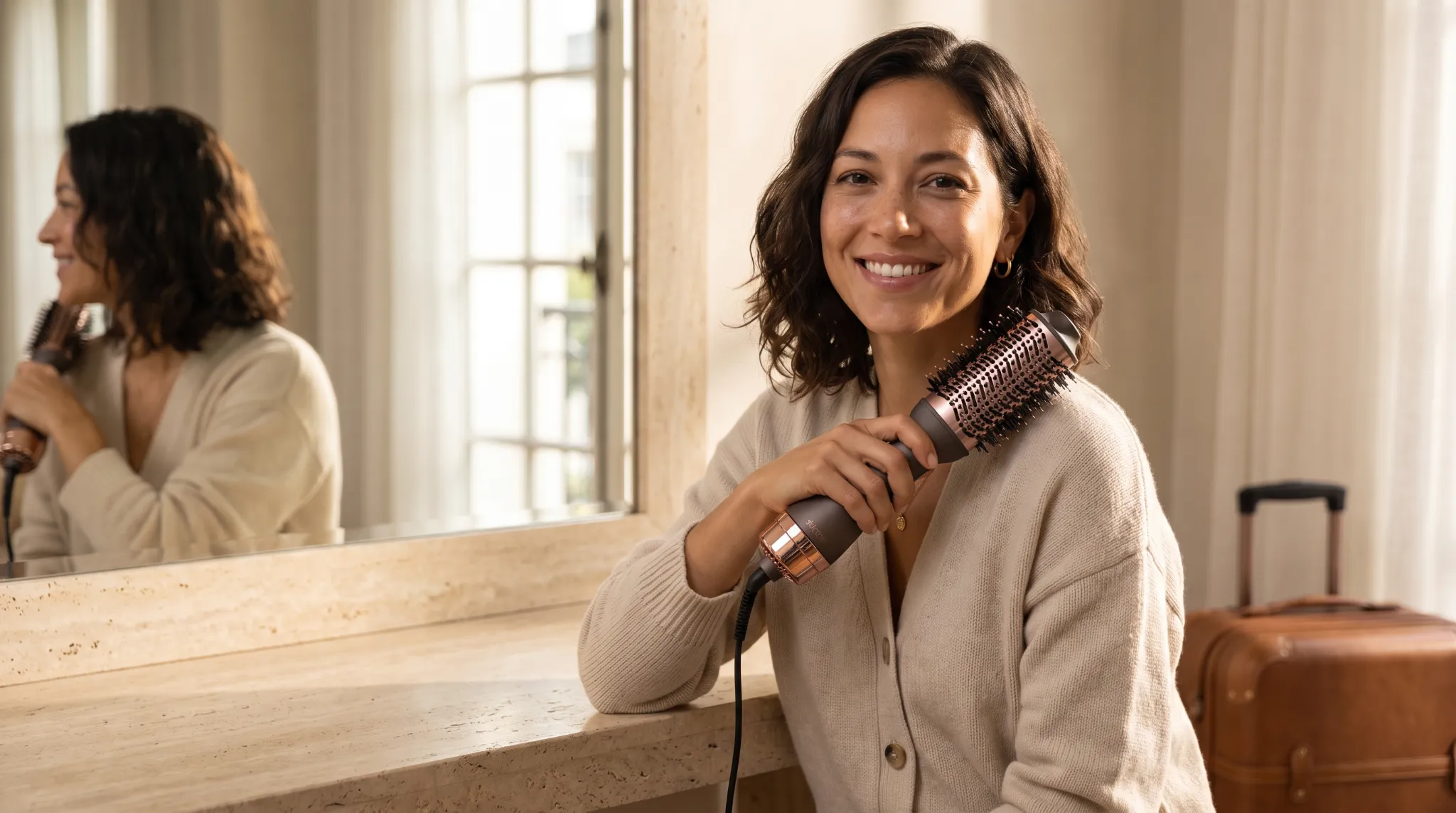
In short: A true travel hair dryer brush combines dual-voltage circuitry (100–120V and 220–240V) with a compact, packable barrel under 2 inches. If you travel internationally, never plug a standard 120-volt styler into a foreign 230-volt outlet with a mechanical pin adapter. The electrical surge will melt internal housings and burn out motor windings within seconds. For safe blowouts on the go, choose a styler with internal dual-resistance coils. Pre-dry hair to 80 percent, and pack multi-tasking formulas that protect cuticles against dry airplane air.
- Dual-Voltage Is Mandatory: Mechanical plug adapters only change pin shapes. If a tool lacks dual-voltage circuitry, European 230V current creates a fourfold wattage surge that destroys the tool.
- Pre-Dry to 80 Percent: Compact travel stylers use 800W to 1000W motors. Never style soaking wet hair. Rough-dry damp strands first with hotel wall dryers.
- Airplane Static Defense: Cabin air humidity drops below 20 percent. This creates strong electrostatic flyaways. Use negative ion emitters to neutralize static charges on hair cuticles.
- Streamline Carry-On Weight: Multi-benefit leave-in sprays eliminate heavy cosmetic bottles. They deliver thermal protection, detangling slip, and cuticle smoothing in one travel-sized container.
- Reset Hydrogen Bonds: Wrap one-inch hair panels firmly around the compact barrel. Apply convective heat under steady tension, then finish with a cool blast to lock in shape.
Travel disrupts your daily styling routine. When you step off a long-haul flight, your hair feels dry, brittle, and staticky. In your hotel bathroom, you face weak water pressure, foreign electrical outlets, and tight vanity counters. If you pack a heavy salon blowout brush from home, it takes up half your luggage space. Worse, if you plug a single-voltage 120-volt tool into a foreign 240-volt socket, you risk tripping hotel circuit breakers, melting internal plastics, and causing an electrical fire.
A compact travel hair dryer brush solves these problems. It gives you professional blowout tension, convective drying airflow, and international electrical compliance in a lightweight frame. If you want full-head blowout transformations at home, explore our testing of the 12 best blow dryer brushes. If you want defined barrel curls and ringlets, read our guide to hot air curling brushes. In this guide, we break down electrical engineering, aviation humidity physics, cuticular electrostatics, and packable travel styling protocols.
Electrical Engineering: Dual-Voltage Physics & Circuit Safety
The primary hazard in international hair styling is electrical voltage mismatch. Power grids vary significantly across different continents. In North America, household wall outlets supply 110 to 120 volts alternating current (AC) at a frequency of 60 Hertz. In the United Kingdom, Europe, Australia, and most of Asia, wall outlets supply 220 to 240 volts at 50 Hertz. Foreign sockets provide more than double the electrical potential of standard American circuits.
A mechanical travel plug adapter only changes the physical shape of the metal prongs so they fit into foreign wall sockets. It does not alter electrical potential. If you plug a single-voltage 120V brush into a 240V socket with only a pin adapter, current spikes instantly. This blows internal thermal cutoffs within seconds.
The Mathematics of Over-Voltage Surges
To understand why single-voltage tools fail overseas, consider Joule’s first law and Ohm’s law. Electrical power dissipation (P) relates directly to voltage (V) and electrical resistance (R) through the equation:
P = V2 / R
A standard 120-volt styling brush rated at 900 watts operates with an internal heating element resistance of roughly 16 ohms (R = 1202 / 900 ≈ 16 Ω). If you connect that same 16-ohm heating coil to a 240-volt European electrical outlet, the power output quadruples:
P = 2402 / 16 = 57,600 / 16 = 3,600 Watts
Connecting a 900-watt heating coil to a 240-volt supply forces 3,600 watts of instantaneous thermal energy through the tool. This 400 percent power surge exceeds the heat dissipation capacity of the mica insulation boards. The temperature quickly surpasses the threshold set by international safety standard IEC 60335-2-23 [1]. Within three seconds, the bi-metallic thermal cutoff fuse melts open to prevent an open flame, destroying the styler permanently.
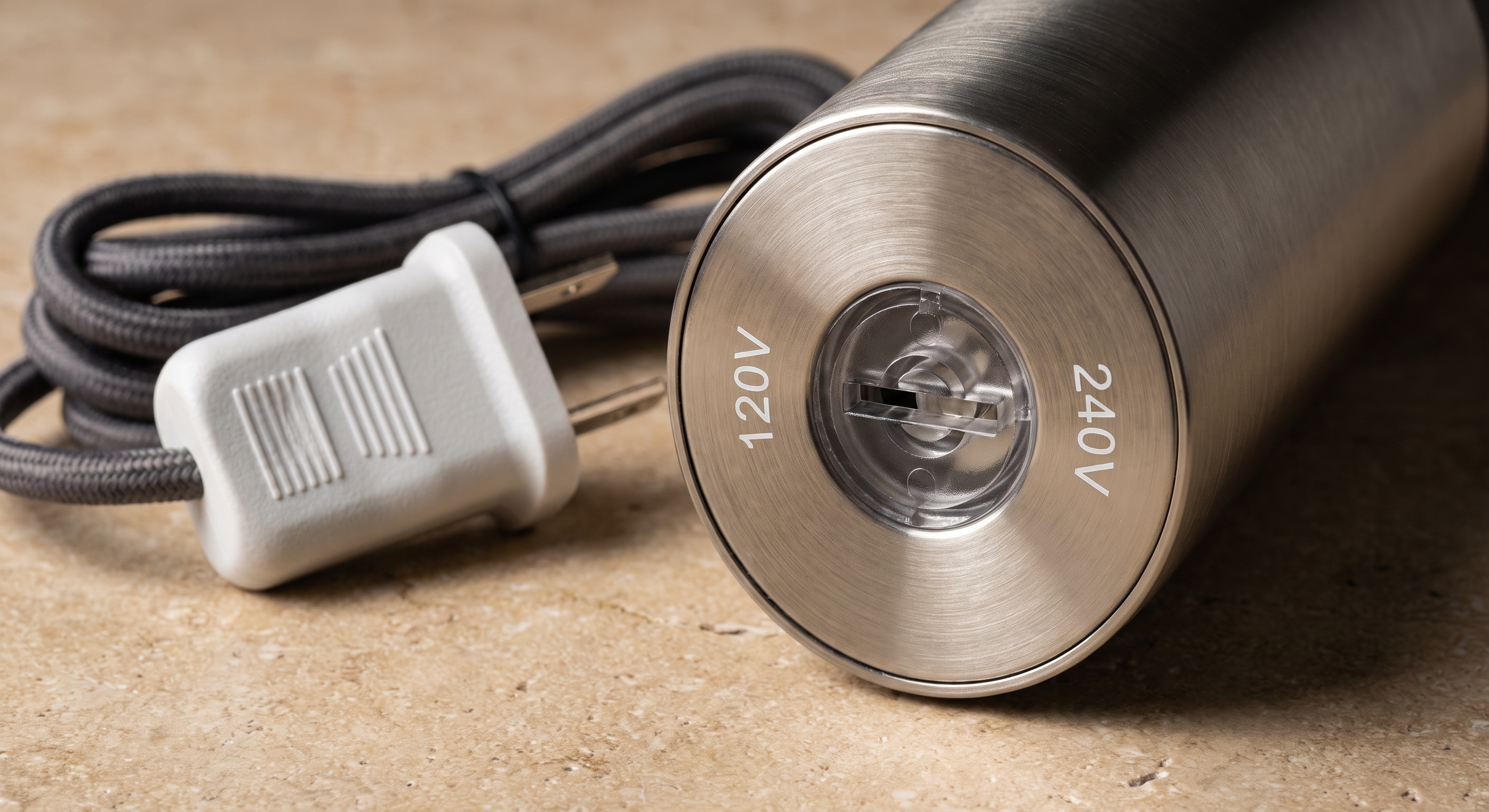
Look for a recessed rotary switch on the handle base. Set the slot to 240V before plugging the styler into European or Asian wall outlets.
Dual-Winding Heating Coil Architecture
A genuine dual-voltage styling brush handles varying electrical supplies through dual-coil wiring topology. Inside the handle, engineers install two separate heating coils and a mechanical rotary switch:
- Parallel Circuit Configuration (120V Mode): When set to 120V, the internal switch connects two 32-ohm heating coils in parallel. This halves the total equivalent resistance to 16 ohms (1 / Req = 1/32 + 1/32 → Req = 16 Ω), producing exactly 900 watts of heat (P = 1202 / 16 = 900 W).
- Series Circuit Configuration (240V Mode): When you turn the rotary selector to 240V, the switch connects the two 32-ohm coils in series. This doubles total resistance to 64 ohms (Req = 32 + 32 = 64 Ω). At 240 volts, power dissipation remains stable (P = 2402 / 64 = 57,600 / 64 = 900 W).
This circuit design maintains constant heat output and motor speed regardless of local grid voltage. In addition, the internal motor drive uses a bridge rectifier with high reverse-breakdown voltage ratings. This protects small DC fans against voltage spikes commonly found in older boutique hotels.
Aerodynamics & Thermal Thermodynamics: Full-Size vs Compact Tools
Full-size salon blowout brushes prioritize broad surface contact and rapid drying volume. They feature wide 2.4-inch to 2.8-inch oval barrels, heavy 1100W to 1300W universal motors, and thick 9-foot swivel cords. While effective for home bathrooms, these dimensions are impractical for carry-on luggage. A full-size blowout tool weighs over 1.6 pounds (725 grams) and consumes roughly 250 cubic inches of packing volume.
A dedicated travel hair dryer brush re-engineers these components to achieve balance between styling tension, convective airflow, and physical packability. Manufacturers achieve this balance by optimizing four primary mechanical variables:
- Barrel Diameter & Curvature: Travel barrels measure between 1.5 inches (38 mm) and 2.0 inches (50 mm) in diameter. The tighter curvature increases mechanical wrap tension on hair strands. This allows smaller motors to smooth unruly cuticles with less convective airflow.
- Calibrated 800W–1000W Motors: Many historic hotels in Europe operate on 10-amp room circuits shared across several outlets. Running a 1500-watt domestic dryer alongside bathroom lighting trips the circuit breaker. An 800W to 1000W motor provides strong air velocity while staying safely within circuit limits.
- Convective Airflow Volume (CFM): Full-size stylers push 50 to 65 cubic feet per minute (CFM) of air. Compact travel brushes deliver 35 to 45 CFM. Because airflow volume is lower, you must rough-dry damp hair to 80 percent before styling.
- Modular Form Factors: Premium travel brushes feature detachable barrel heads or folding handles. Detachable mechanisms use spring-loaded ball detents to separate the cylinder from the motor handle. This reduces total packed length from 14 inches down to less than 8 inches.
Leading thermal engineering brands, such as l’ange hair care, build compact stylers with titanium-infused cores and dense tufted bristles. These materials maximize heat transfer and mechanical tension, allowing travelers to achieve polished blowouts without carrying heavy salon equipment.
Tool Architecture & Engineering Specifications Matrix
Compare the mechanical specifications, electrical configurations, and packing footprints across primary hot air styling categories:
| Tool Architecture | Electrical Configuration | Motor & Power Draw | Barrel Diameter & Core | Airflow Output (CFM) | Packed Weight & Length |
|---|---|---|---|---|---|
| Dual-Voltage Mini Oval Brush | Dual (120V / 240V manual switch) | 800W – 900W DC Motor | 2.0 in (50 mm) Ceramic / Titanium | 38 – 42 CFM | 0.95 lbs (430 g) • 10.5 in |
| Compact Cylindrical Round Brush | Dual (120V / 240V manual switch) | 750W – 850W DC Motor | 1.5 in (38 mm) Tourmaline Ceramic | 32 – 36 CFM | 0.85 lbs (385 g) • 9.8 in |
| Modular Detachable-Head Styler | Dual (100–120V / 220–240V auto/switch) | 900W – 1000W High-RPM Motor | 1.8 in (45 mm) Ceramic Coated | 40 – 45 CFM | 1.05 lbs (475 g) • 7.5 in (detached) |
| Folding Dryer + Ceramic Brush Kit | Dual (120V / 240V manual switch) | 1000W – 1200W DC Motor | Separate 1.7 in Round Brush | 45 – 50 CFM | 1.20 lbs (545 g) • 8.0 in (folded) |
| Full-Size Salon Volumizer (Home Baseline) | Single Voltage (120V only) | 1100W – 1300W Universal Motor | 2.8 in (71 mm) Wide Oval Core | 55 – 65 CFM | 1.65 lbs (750 g) • 14.2 in |
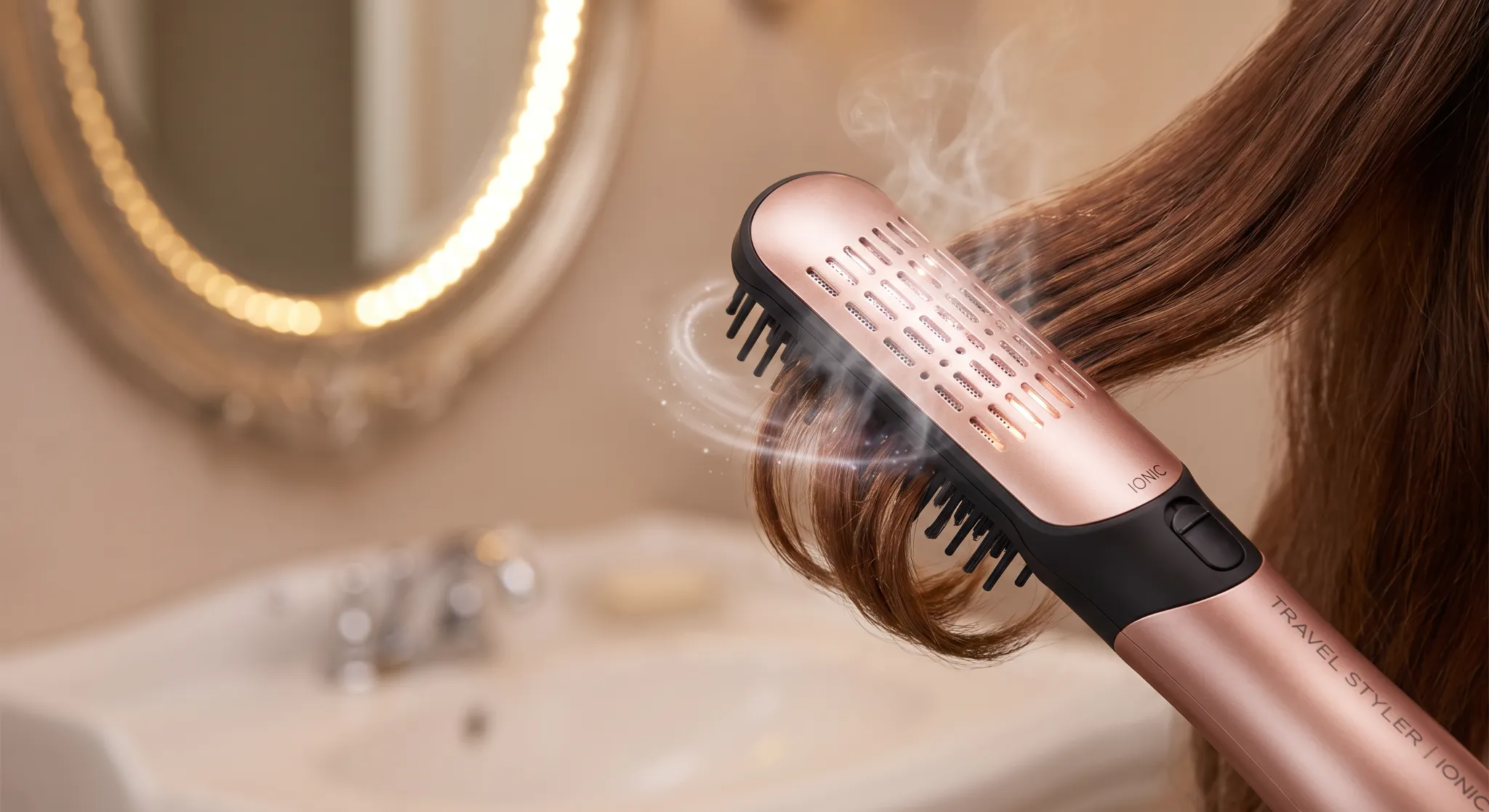
Work in narrow one-inch panels. Smooth through mid-lengths with steady tension to seal cuticles and neutralize travel static.
Aviation Environmental Physics: Combatting Airplane Static & Flyaways
Commercial aircraft cruise at altitudes between 30,000 and 42,000 feet. At these altitudes, outside ambient temperatures range from -40°C to -60°C. In accordance with the Clausius-Clapeyron equation, extremely cold air holds almost no water vapor. Aircraft Environmental Control Systems (ECS) draw in this dry exterior air, pressurize it, and heat it to a comfortable cabin temperature [2].
As the air warms, its relative humidity (RH) plummets to between 10 and 18 percent. For comparison, typical indoor environments maintain 40 to 60 percent humidity, and the Sahara Desert averages 25 percent. This severe atmospheric moisture deficit rapidly leaches bound water out of the hair cortex, destabilizing hair fiber electrostatics.
The Triboelectric Charging of Keratin Fibers
Human hair is constructed of fibrous keratin proteins rich in disulfide bonds. When relative humidity drops below 20 percent, hair keratin acts as a dielectric electrical insulator with very high surface resistivity (> 1012 Ω/sq) [3]. Under normal humidity, ambient water molecules adsorb onto the hair surface. This thin hydration film conducts stray electrical charges away safely.
In a dry airplane cabin, that protective hydration film vanishes. When you rest your head against aircraft seats made of synthetic nylon, polyester, or wool blends, friction strips electrons away. On the triboelectric series, human hair sits on the positive end [3]. Hair readily surrenders valence electrons to synthetic seat fabrics, accumulating an intense positive electrostatic charge (+Q).
Because every hair fiber accumulates the same positive electrical charge, Coulomb’s law drives electrostatic repulsion:
F = ke · (q1 · q2) / r2
Like charges repel. Individual hair fibers push violently away from each other. This electrical force lifts the shingle-like cuticular scales away from the hair shaft, producing erratic flyaways, tangles, and rough fiber friction [3, 4].
Active Negative Ion Neutralization
A high-grade travel hair dryer brush incorporates negative ion generators, such as tourmaline ceramic coatings or active corona discharge pins. As convective air flows over the heating elements, the ionizer releases a stream of negatively charged air ions (primarily superoxide anions, O2−). When these negative ions collide with positively charged hair strands, they transfer electrons back to the keratin molecules.
This electron transfer neutralizes the electrostatic charge. Coulombic repulsion collapses instantly. Cuticle scales flatten against the cortex, locking in internal moisture and restoring optical shine [4].
Scalp Sebum Dynamics & Dehydration Feedback Loops
Travelers often notice an annoying paradox: after hours in dry airplane air, their ends feel dry like straw, but their roots look limp and greasy. This issue results from transepidermal water loss (TEWL) and reactive sebum overproduction.
The scalp stratum corneum functions as an epidermal barrier. When exposed to cabin air below 20 percent relative humidity, moisture evaporates rapidly through the epidermis. Epidermal sensory pathways detect this barrier dehydration. In response, sebaceous glands produce an emergency surge of squalene, wax esters, and triglycerides to coat the scalp surface with an occlusive lipid layer [5, 6].
Frequent touching to smooth staticky flyaways transfers natural skin oils from fingertips directly onto hair roots. Meanwhile, the mid-lengths and ends receive no natural sebum and remain parched. This creates greasy roots paired with brittle, dehydrated tips.
Destination tap water can worsen this problem. Many cities use hard municipal water filled with dissolved calcium (Ca2+) and magnesium (Mg2+) ions. When hard water mixes with hotel shampoo, fatty acids precipitate into insoluble calcium stearate curd. This residue coats the hair cuticle, increasing surface friction, blocking moisture absorption, and making blowouts look dull.
The Minimalist Travel Routine: Multi-Benefit Formulas
Aviation security regulations (such as TSA 3-1-1 rules) limit carry-on liquids to containers of 3.4 ounces (100 milliliters) or less, packed inside a single clear quart-sized bag. Packing separate bottles for detangling, heat protection, smoothing serums, and gloss sprays wastes valuable space and increases leak risks. Experienced travelers rely on concentrated, multi-functional formulas.
In multi-tasking hair care, uniq one hair care (Revlon Professional UniqOne All In One Treatment) is an industry-recognized benchmark. A single travel-sized spray bottle provides multiple proven protective benefits. It shields hair cuticles against heat up to 230°C (446°F), detangles knots, smooths flyaway frizz, protects cosmetic color, and restores shine with hydrolyzed keratin and silk amino acids. Applying four to six pumps to damp hair before rough-drying eliminates the need for extra styling products.
For travelers who embrace ultra-lightweight routines, adopting spartan hair care products keeps luggage light and organized. A spartan travel routine relies on three essentials: a solid shampoo bar that avoids liquid restrictions, a high-performance leave-in thermal conditioning spray, and a compact dual-voltage blowout brush. This streamlined kit eliminates excess weight, avoids messy luggage spills, and delivers polished blowouts anywhere.
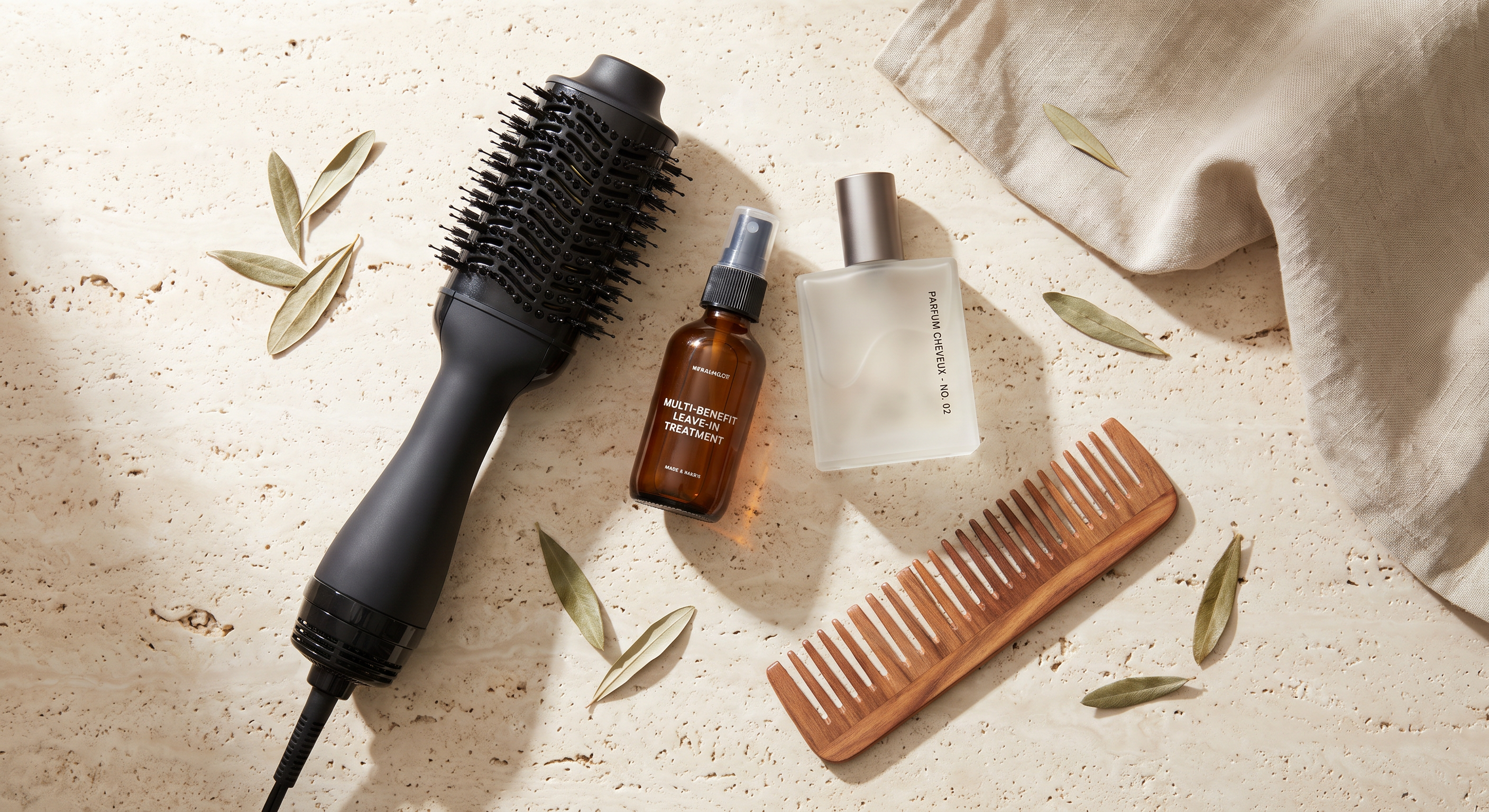
Streamline your travel kit with a dual-voltage styling brush, a multi-benefit leave-in spray, and an alcohol-free hair fragrance mist.
Blowout Longevity on the Move: Hair Mists & Ambient Oils
Washing your hair daily while traveling is often impractical and strips your scalp of natural lipids. Frequent washing in hard hotel water coats hair shafts with mineral scale. To keep your blowout fresh for three to four days without washing, use dry powder cleansing and targeted scent mists.
Never spray traditional eau de parfum or body mist directly onto your hair. Standard perfumes contain 70 to 80 percent ethyl alcohol (denatured ethanol). Ethanol dissolves protective surface cuticular lipids, accelerating moisture evaporation and causing split ends. Instead, choose a dedicated hair fragrance mist. Quality hair perfumes use water or lightweight silicone bases infused with argan or camellia seed oils. They deposit pleasant scent molecules while sealing cuticle edges and neutralizing travel odors.
To improve stale hotel room environments, frequent travelers often carry a compact waterless scent device. Pairing a portable travel atomizer with a clean diffuser fragrance refreshes dry room air. Adding a botanical diffuser fragrance oil containing lavender or cedarwood transforms your hotel bathroom into a relaxing spa, making your travel styling routine comfortable and restorative.
Step-by-Step Hotel Room Blowout Protocol
Achieve a lasting, salon-quality blowout in any hotel bathroom by following this five-step styling protocol:
- Squeeze and Pre-Dry to 80 Percent: Gently press wet hair with a microfiber towel. Do not rub vigorously, as friction damages wet cuticles [4]. Use the hotel wall dryer to rough-dry hair until it is 80 percent dry and slightly damp to the touch. Compact travel brushes lack the wattage to dry soaking wet hair efficiently.
- Distribute Multi-Benefit Thermal Protection: Spray four to six mists of a multi-benefit leave-in treatment across mid-lengths and ends. Comb through with a wide-tooth travel comb to distribute heat protectants and detangling agents evenly.
- Inspect the Voltage Selector Switch: Before plugging the tool into the wall, check the recessed switch on the base of the handle. For North America, confirm the switch reads 120V. For the UK, Europe, Australia, or Asia, rotate the slot with a coin until it indicates 240V. Securely insert the appropriate regional plug adapter.
- Section and Style Under Mechanical Tension: Divide hair into four quadrants using travel sectioning clips. Work in narrow one-inch panels. Place the brush barrel directly under the root zone, lift upward for crown volume, and draw the barrel slowly through to the tips under firm, steady tension. Roll the barrel inward at the ends for a polished curve.
- Reset Hydrogen Bonds with Cool Air: Once a section is dry and smooth, switch the airflow setting to cool for five to eight seconds. Convective heat temporarily softens the keratin hydrogen bonds; cool airflow resets them into their new, smoothed shape, locking in volume and bounce [4].
Frequently Asked Questions
How use hair wax?
To use hair wax for taming travel flyaways and baby hairs, warm a small pea-sized amount between your fingertips until the formula turns translucent and soft. Lightly glide your fingers over unruly strands along your parting, hairline, and crown. Hair styling wax uses natural beeswax, microcrystalline wax, or candelilla wax to create a flexible, hydrophobic film over hair fibers. This seals moisture out and holds flyaways flat without flaking or stiffening like alcohol gels. When packing light, use a solid wax stick. It glides directly over hair without leaving sticky residue on your hands.
How long should your hair be to wax?
For depilatory body waxing before a vacation, hair should measure roughly one-quarter inch long (about six millimeters), which matches the size of a long grain of rice. Reaching this length generally requires two to three weeks of natural growth after your last shave. If hair is shorter than one-quarter inch, hot or strip wax cannot achieve enough mechanical grip on the hair shaft. This causes hairs to break above the skin surface instead of extracting cleanly from the follicle bulb. If hair is longer than one-half inch, trim it slightly before waxing to reduce skin pulling and minimize discomfort.
Why is my hair so staticky?
Hair becomes staticky when dry air and mechanical friction strip surface electrons, leaving hair fibers with an unbalanced positive electrical charge. Airplane cabins, winter heating systems, and dry hotel rooms drop ambient relative humidity below 20 percent. Without atmospheric moisture to form a conductive layer and drain electrical charge, like-charged positive strands violently repel each other according to Coulomb’s law. To stop static instantly, style with an ionic travel brush that releases negative air ions, or apply a light leave-in conditioner with cationic conditioning agents that neutralize surface charges.
Why does my hair get greasy so fast?
Hair becomes greasy quickly during travel due to reactive sebum production and hard water mineral deposits. When dry airplane air causes rapid transepidermal water loss on your scalp, sebaceous glands produce an emergency layer of squalene and wax esters to restore the epidermal lipid barrier. In addition, hard hotel water containing dissolved calcium and magnesium binds to shampoo surfactants, leaving insoluble mineral residues at your roots. Frequently running your hands through your hair to control flight static also transfers natural oils from your fingers directly onto your scalp.
Do you brush before whitening strips?
Do not brush your teeth immediately before applying peroxide whitening strips during your travel grooming routine. Toothbrush bristles create microscopic abrasions and temporary inflammation on delicate gum tissue. If concentrated hydrogen peroxide or carbamide peroxide gel contacts freshly abraded gums, it causes painful chemical irritation and white blanching spots. Instead, brush your teeth at least 30 minutes before applying whitening strips, or rinse your mouth thoroughly with clean warm water to clear loose food debris before application.
How long does it take for hair to grow back?
Human scalp hair grows at an average biological rate of approximately one-half inch (1.25 centimeters) per month, which equals roughly six inches per year. Individual hair follicles follow an active proliferation phase known as anagen that lasts two to seven years. If travel stress, circadian disruption, or illness triggers temporary shedding (clinically termed telogen effluvium), recovery takes three to six months. Once the physical stress passes, resting follicles re-enter the anagen cycle and begin producing healthy new hair fibers.
Scientific References & Technical Standards
- International Electrotechnical Commission (IEC). (2019). IEC 60335-2-23: Household and similar electrical appliances – Safety – Part 2-23: Particular requirements for appliances for skin or hair care (Edition 6.0). Geneva, Switzerland: IEC Central Office.
- American Society of Heating, Refrigerating and Air-Conditioning Engineers (ASHRAE). (2018). ASHRAE Standard 161-2018: Air Quality within Commercial Aircraft. Atlanta, GA: ASHRAE.
- Robbins, C. R. (2012). Chemical and Physical Behavior of Human Hair (5th ed.). New York, NY: Springer-Verlag. ISBN: 978-3-642-25610-3. (Focus: Cuticular triboelectric charging, surface resistivity, and moisture sorption isotherms).
- Lee, Y., Kim, Y. D., Hyun, H. J., Pi, L. Q., Jin, X., & Lee, W. S. (2011). Hair shaft damage from heat and drying time of hair dryer. Annals of Dermatology, 23(4), 455–462. DOI: 10.5021/ad.2011.23.4.455.
- Dawber, R. (1996). Hair: Its structure and response to cosmetic preparations. Clinics in Dermatology, 14(1), 105–112. DOI: 10.1016/0738-081X(95)00117-X.
- Draelos, Z. D. (2005). Hair cosmetics. Dermatologic Clinics, 23(4), 605–617. DOI: 10.1016/j.det.2005.05.012.
- Paus, R., & Cotsarelis, G. (1999). The biology of hair follicles. New England Journal of Medicine, 341(7), 491–497. DOI: 10.1056/NEJM199908123410706.
- American Academy of Dermatology (AAD). (2022). Telogen Effluvium and Hair Shedding: Clinical Guidelines and Pathophysiology. Rosemont, IL: AAD.