
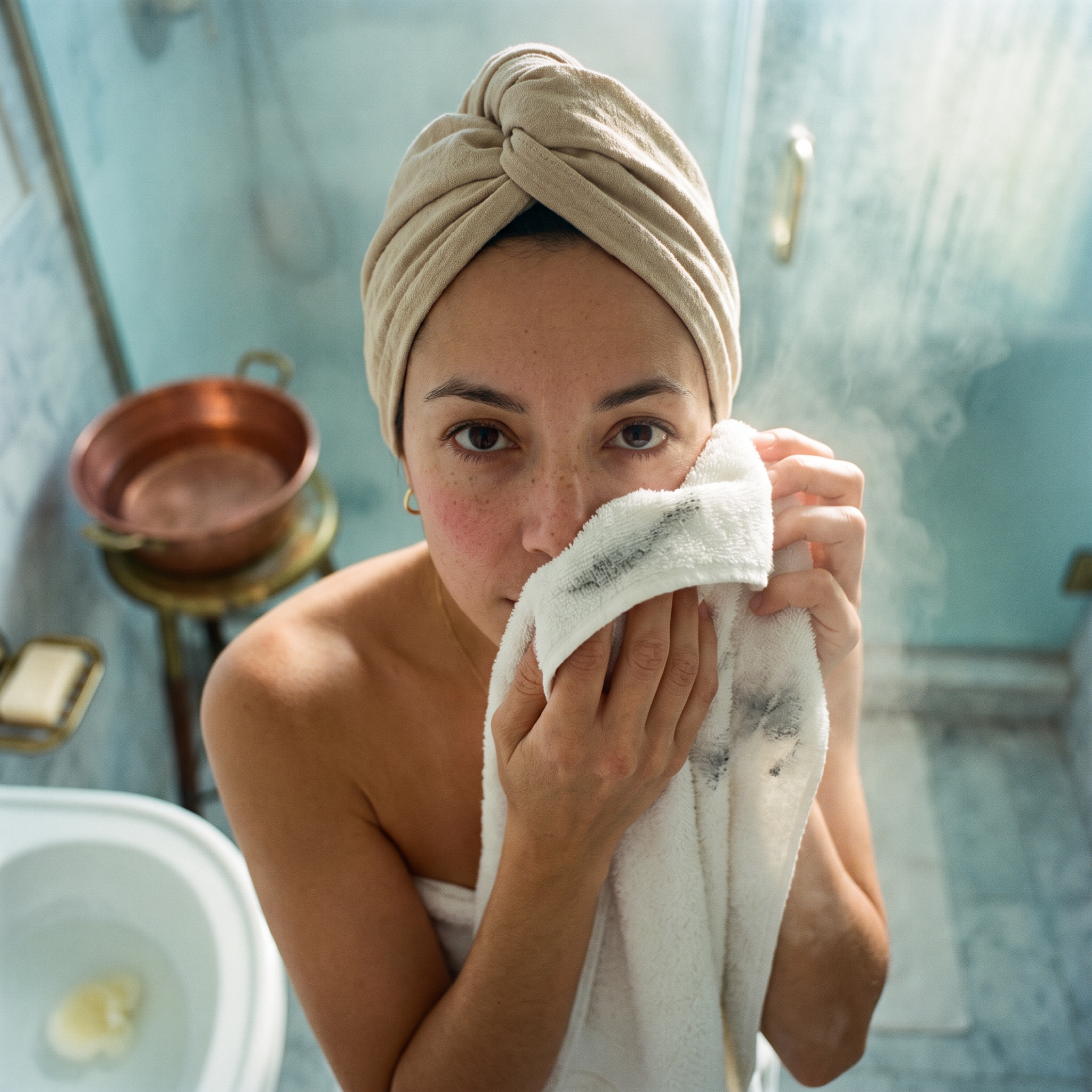
- Oil dissolves oil. In a measured study, water left 59 percent of a waterproof sunscreen behind. Cleansing oil left about 6 percent.
- Waterproof means oil-soluble. That is the whole trick of the formula.
- Order matters. An oil step first to dissolve the film, then a water-based step to rinse it away.
- Coconut oil works and carries a real acne risk. Both things are true.
- Do not put lemon or lime juice on your face. It is phototoxic and can burn.
- Never use baby shampoo on your lashes. Trials found it damages the cells that keep your eyes moist.
Why Oil Dissolves Makeup and Water Cannot
Every makeup remover answers one question. What dissolves this film? For waterproof mascara and long-wear foundation, the answer is oil. Water cannot lift a film that was built to resist water. That single fact explains why some homemade removers work and others fail.
Waterproof makeup holds together with oil-loving polymers. These polymers are lipophilic, which means they mix with oil and not with water. A lipophilic film will not dissolve in a water-based solvent, because like dissolves like. Water can wet the film and rinse away loose pigment. It cannot break the polymer bonds. An oil loosens the film from the outside and lifts it away whole.
The measured evidence is the clearest way to see the gap. A 2019 study compared three removers on waterproof sunscreen, then measured what was left on the face. Water alone left 59.3 percent of the product behind. A foaming cleanser left 36.8 percent. A cleansing oil left 5.8 percent, which is statistically the same as clean skin. The same study found that the people using the foaming cleanser reported dry skin eight times more often than the people using oil.
Read those numbers together and the practical rule writes itself. An oil-based step is the only one of the three that fully removes a waterproof film. It is also the gentler one. That second result matters, because the drying that a harsh cleanser causes is the start of barrier damage.
- Waterproof mascara uses oil-soluble film-forming polymers, such as trimethylsiloxysilicate, a silicone resin, and acrylate copolymers. They dry into a continuous film around each lash.
- Because that film is lipophilic, water beads on it instead of penetrating it. This is a deliberate formulation choice, not a defect.
- The same property that helps mascara survive tears and rain also helps it survive an ordinary face wash.
- Removing it needs a solvent that matches the film chemistry: an oil, a balm, or a purpose-made dual-phase eye remover.
This is also why a long-wear base is hard to take off. A formula built to grip all day is, by design, a film. The long-wear luxury foundations we tested are the clearest example of that trade. The better they wear, the more they need an oil step at the end of the day. The base chemistry runs in both directions, and taking the film off is the mirror of putting it on.
Balm, Oil and Micellar Water: What Each One Actually Is
| Form | Base | Lifts waterproof makeup | Rinses clean | Best for |
|---|---|---|---|---|
| Cleansing balm | Oils plus waxes and emulsifiers | Yes | Yes, if emulsified | Heavy or waterproof makeup |
| Cleansing oil | Oils plus emulsifiers | Yes | Yes, if emulsified | Heavy or waterproof makeup |
| Micellar water | Almost entirely water | Partly, not reliably | No rinsing needed | Light makeup, sensitive skin |
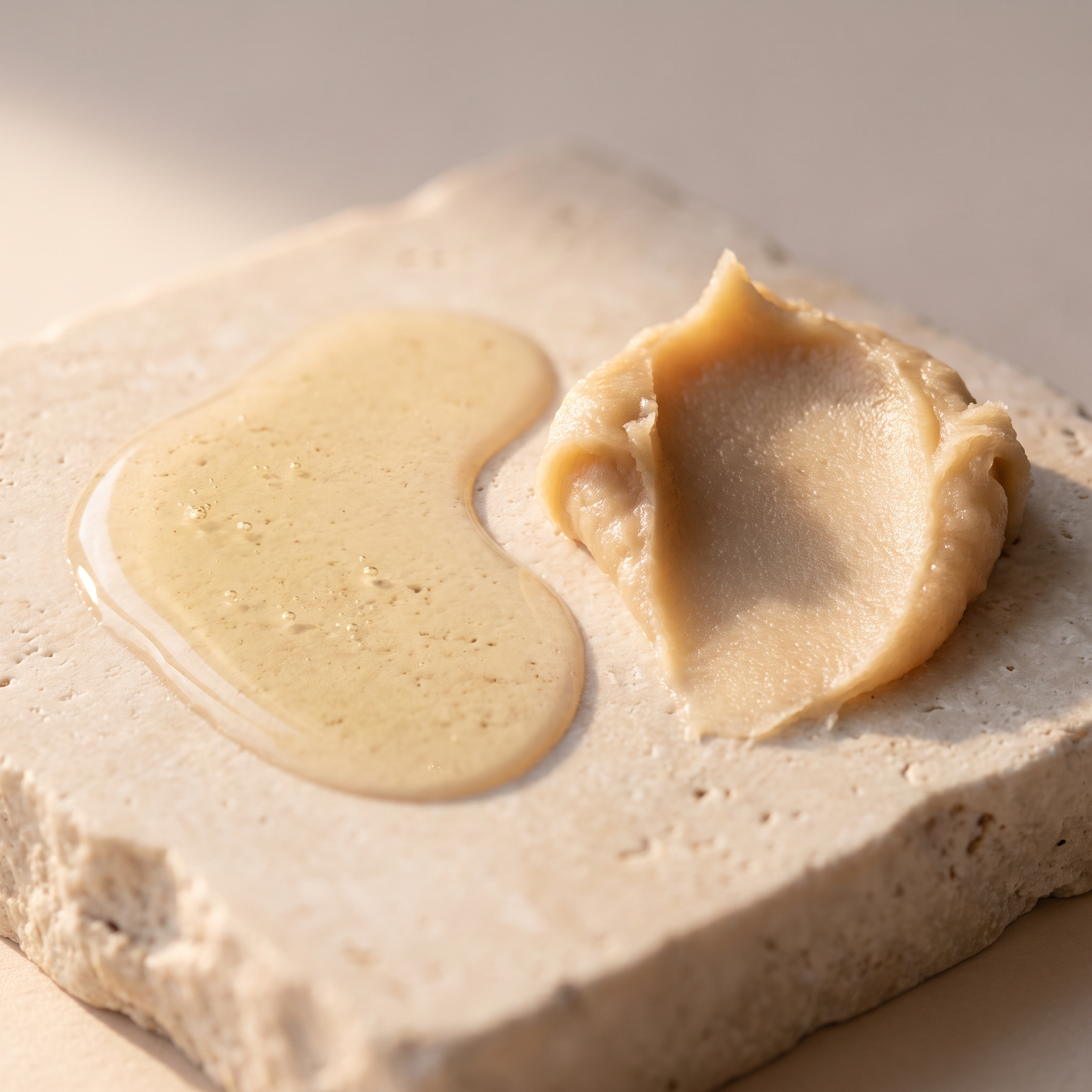
Three formats remove makeup, and they are not interchangeable. A cleansing balm is a solid blend of oils, waxes and emulsifiers. It melts at skin temperature and turns to oil on contact. It dissolves the makeup film, then mixes with water so it rinses away without a greasy layer. A cleansing oil is the same idea in liquid form. It carries emulsifiers that turn milky white when water is added, and that color change is the signal it will rinse clean.
A micellar water is almost entirely water. It carries a very low concentration of surfactant. A surfactant is the molecule that lets oil and water mix, with one end that loves water and one end that loves oil. Above a threshold concentration, those molecules clump into tiny spheres called micelles, with their water-loving heads facing out and their oil-loving tails facing in. Dirt and oil get trapped in the oil-loving center. Because the concentration is low, micellar water is mild. That same low concentration is why it cannot dissolve a waterproof film on its own.
There is a second reason micellar water is gentle, and it is the same reason it is limited. The threshold at which surfactant molecules start forming micelles is called the critical micelle concentration. Micellar waters sit at or just above it. That is enough to lift light makeup, sebum and daily grime. It is not enough surfactant to break a heavy water-resistant polymer film. So micellar water is a fine single step on a light day, and a first step rather than the only step on a waterproof day.
Surfactant class decides how a product feels on skin. Anionic surfactants, such as sodium lauryl sulfate, carry a negative charge, bind skin proteins strongly, and cause the most irritation and after-wash tightness. Non-ionic surfactants carry no charge and interact far less. That is why the gentlest formulas use PEG-based non-ionic surfactants rather than sulfates. If you are pairing layers rather than stripping them, match one product’s chemistry to the next. That same logic runs through how water-based primers are built to pair.
Light makeup or no makeup: a micellar water is enough. Long-wear or waterproof makeup: start with a balm or oil, then follow with a gentle cleanser. High-SPF sunscreen: treat it like waterproof makeup, because it is a film too.
The Removal Order That Protects Your Barrier
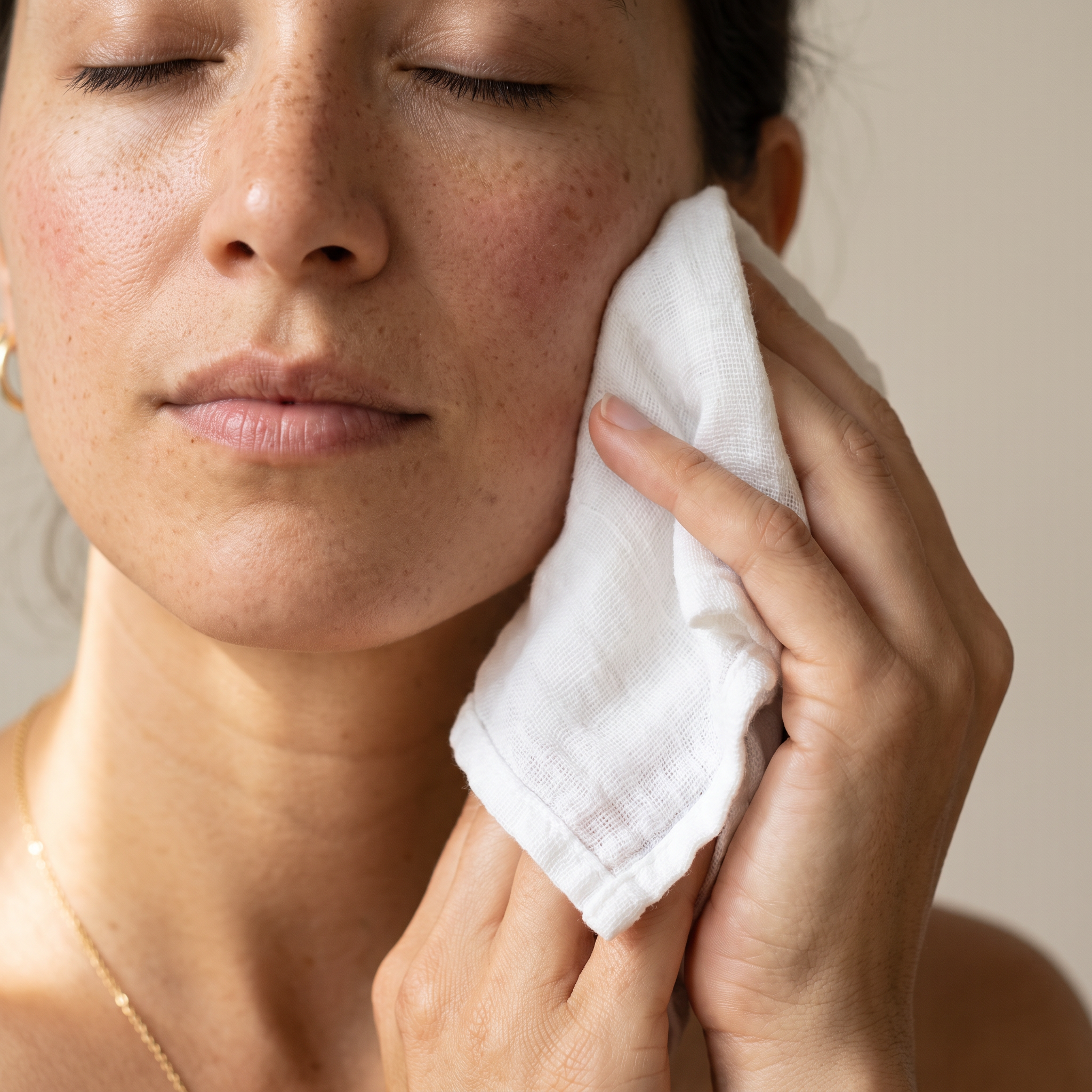
Order matters more than product, and the reason is the same like-dissolves-like rule. Water first would leave the waterproof film intact, and the oil would then have to fight through it.
- Massage an oil or balm into dry skin. This is the step that lifts the film.
- Emulsify with water. This is the step people skip. Keep adding water and massaging until the product turns milky white.
- Rinse, then follow with a gentle water-based cleanser at a pH near 5.5.
The two steps do two different jobs. The oil step dissolves the lipophilic film that water cannot touch. The water step then removes the oil itself, along with sweat, dead cells and the day’s grime. Leaving a film of cleansing oil on the skin is its own problem, so the second step is not optional.
For the eye, the technique is the safety instruction. Soak a pad, hold it against the lashes for several seconds, then wipe downward with the lid closed. Do not scrub. Friction does not dissolve a polymer film, so scrubbing only adds damage without removing more product.
Two cleansing steps are not right for everyone. If your barrier is already compromised or reactive, use one gentle oil step instead. Each cleansing step is an opportunity for surfactant exposure, and that damage is additive. Surfactants do not distinguish between the oil you want to remove and the lipids your skin needs. They extract both.
pH matters on its own, even with no surfactant present. A high-pH product swells the outer skin layer and disturbs its lipid structure. So a neutral or acidic cleanser close to the skin’s normal pH of about 5.5 is less damaging.
Two terms are worth knowing here, because they describe what you are protecting. Transepidermal water loss is the amount of water vapor escaping through the skin. The natural moisturizing factor is the mix of water-attracting compounds inside the outer skin that keeps it hydrated. Surfactants pull the barrier lipids out, and water then escapes through the gaps. The natural moisturizing factor is water-soluble, so washing extracts that too. Two different losses: lipids out, water gone.
Two cleansing steps can be too much for a skin barrier that is already struggling. On reactive skin, use one gentle oil step instead. Emulsify it fully with water and rinse well. Adding a second wash adds surfactant exposure, and that damage adds up.
Which Homemade Routes Work, and Which Are Unsafe
| Home route | Works? | Verdict | Reason |
|---|---|---|---|
| Coconut oil | Yes, lifts makeup | Caution | Comedogenic risk rated 4 of 5 |
| Olive oil | Lifts makeup | Avoid as a leave-on | Reduced skin barrier integrity over 4 weeks |
| Sunflower seed oil | Lifts makeup | Best of the oils | Preserved barrier in the same study |
| Baby shampoo | Cleans lashes | Avoid | Damaged tear-film cells in trials |
| Lemon or lime juice | No | Avoid, unsafe | Phototoxic; causes burn-like reactions |
| Witch hazel | No, not as a remover | Caution | A drying astringent; does not dissolve oil |
| Essential oils | No, not as a remover | Caution | Common contact allergens; 8 hospitalisations in one study |
This is the section the article exists for. Every top result for this query is a recipe page. Not one of them warns that lemon juice is phototoxic or that baby shampoo damages the tear film. So here is the honest verdict on each route.
Coconut oil. The mechanism works and the side effect is real. Coconut oil is high in lauric acid, a straight-chain fatty acid that readily penetrates the follicle and promotes comedone formation. It is rated 4 on the standard 0 to 5 comedogenicity scale. If your skin is oily or prone to breakouts, this is a bad trade. If it is not, it still leaves a heavy film. State the scale honestly: its foundations are weak. The rabbit-ear assay behind those ratings gave inconsistent results on human skin. The methods test isolated ingredients rather than finished formulas, and the word noncomedogenic is unregulated. Treat the rating as a strong signal of risk from an imperfect but widely used scale, not as a precise measurement. That covers the related search for a non comedogenic makeup remover honestly.
Olive oil. The picture is genuinely mixed, and it must be described that way. The strongest mechanistic study tested four weeks of topical olive oil. It found significantly reduced stratum corneum integrity and mild redness. Both effects appeared with and without a history of atopic dermatitis. Sunflower seed oil preserved integrity in the same study and caused no redness. A later randomised study found the opposite for hydration and turnover. The safe conclusion is not that olive oil is poison. It is that olive oil is not a proven safe leave-on or cleansing oil, and sunflower oil has the better documented record.
Lemon and lime juice. This route is an outright safety fail, not a preference. Citrus juice contains furocoumarins, including psoralens such as bergapten. Applied to skin and then exposed to UVA light, these compounds cause phytophotodermatitis, a burn-like phototoxic reaction. The psoralen enters the skin cells and UVA light activates it, triggering a delayed inflammatory reaction hours to a day later. That delay is why people do not connect the two events. It presents as streaky or odd-shaped redness that can blister, and it can leave long-lasting dark marks. A remover is applied to the face and left on briefly, but the residue that stays behind puts you directly in that exposure scenario. There is no safe amount here.
Baby shampoo. This is the single most useful myth to correct. Clinical trials found that 1 to 10 diluted baby shampoo sharply decreases MUC5AC secretion. That points to damage to the conjunctival goblet cells, which make the mucus layer of the tear film. The DIY community recommends it as the safe eye option. The clinical ophthalmology literature says the opposite.
Witch hazel. Witch hazel is a tannin-rich astringent, and astringent is not the same as gentle. Tannins bind and precipitate proteins, which produces the tightening feel and a drying effect. It is not a makeup solvent. It does not dissolve an oil film, so it cannot do the job. Its honest role is as a toner for oily, non-reactive skin, and even then not as a remover. This one is a mechanism-based conclusion from the barrier and cleanser literature rather than a witch-hazel-specific trial.
The natural-means-gentle fallacy. Natural describes origin, not safety. A French dermatology study looked at 42 patients with allergic contact dermatitis to essential oils. The most common sensitizers were lavender, tea tree and ravintsara. Eight of those patients needed hospital treatment. Limonene and linalool are the most common fragrance allergens and must be declared on cosmetic labels above set thresholds. A plant-derived oil can be a stronger allergen than a synthetic alternative. Think about the layer that goes on under all of this. For that step, a tinted BB cream you can remove gently is the right pairing. It suits anyone who wants a light everyday base rather than a waterproof film.
Do not use lemon or lime juice. Citrus juice contains compounds that react with sunlight and can cause a burn-like rash, sometimes with lasting dark marks. Do not use baby shampoo on your lashes; trials found it damages the cells that keep your eyes moist. Do not scrub waterproof mascara off with friction. Dissolve it, then wipe gently.
If You Want the Result Without the Risk
The evidence above supports the mechanism and not the kitchen method. Every supportable home route is either weaker than a formulated product or is essentially the formulated product already.
Here is what a formulated balm gives you that a kitchen oil cannot. Emulsifiers, so it turns milky and rinses clean instead of sitting on your skin. Preservatives, so a jar that spends months in a bathroom does not grow bacteria. A tested pH, so the product does not swell the outer skin layer. And ocular safety testing, if it is an eye product, which a bottle of kitchen oil has never had. None of these is a marketing extra. Each one is a specific failure mode removed.
The three forms map onto three different readers. If you wear heavy or waterproof makeup and want a fragrance-free option, a solid balm is the direct answer. If your skin is reactive and your makeup is light, a micellar water with a short ingredient list is enough and needs no rinsing. If your skin is textured, you may want removal plus light surface exfoliation. An emulsifying balm built on sunflower seed oil is the better documented oil base for that job. Match the form to your day, not to the loudest claim.
Whichever you choose, read the ingredient list the way the evidence does. Look for an oil or emollient ester first. Look for emulsifiers further down, which is what makes the rinse work. Look for a non-ionic surfactant rather than a sulfate, if the product is water-based. That is the whole chemistry, and it is printed on the pack.
Protecting the Eye Area
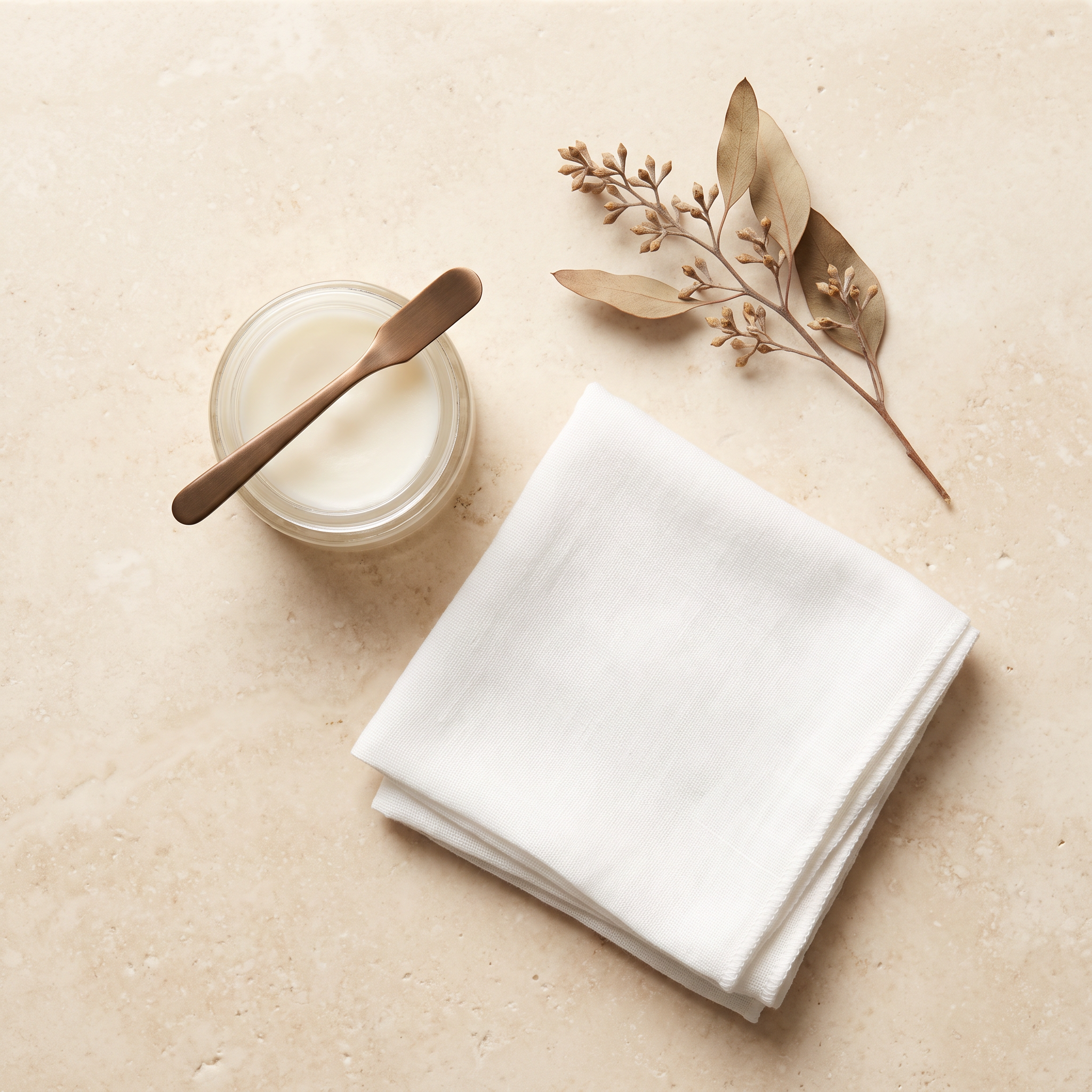
The eye area has its own anatomy, and it makes this step different from the rest of the face.
The eyelid margin holds the meibomian glands, the oil glands that make the oil layer of your tear film. Blocked or inflamed meibomian glands are a leading cause of dry eye. When the eye is closed, a fold of skin covers the margin, so ordinary washing does not clean it. Makeup, sebum and dead cells collect at the lash roots and the gland openings. An unclean margin encourages overgrowth of a microscopic mite linked to eyelid inflammation, and it blocks the gland openings.
The literature is explicit in both directions. It is important to clean the lid margin, and aggressive or repeated cleaning can itself start or worsen dry eye. So the technique has to be gentle by design.
- Soak a cotton pad with an oil-based or dual-phase remover.
- Hold it against the closed lid for several seconds. Let the product dissolve the film before you move.
- Wipe downward, away from the lash line, with the eye still closed.
- Use a fresh pad for the second eye.
Never use baby shampoo for this, whatever a recipe says. Hold, do not scrub. Friction is what damages the margin and the skin around it, and it removes no extra product.
One more sign to take seriously. If a remover stings, that is barrier damage, not proof that it is working. A product that stings is the wrong product, not a strong one. If irritation, redness or persistent dryness continues, or the eye stays gritty or watery between uses, that needs a clinician rather than a stronger remover.
A remover should not sting. Stinging is barrier damage, not proof that a product is working. See a clinician if irritation, redness or persistent dryness continues, or if the eye stays gritty or watery between uses. That needs a diagnosis, and Beautyisles does not provide one.
Cotton makeup remover pads are the cheapest part of this routine and the easiest to waste. Soak until the pad feels heavy, then hold it still. A dry pad pulls, and pulling is what damages lashes.
Frequently Asked Questions
How to remove waterproof mascara?
Use an oil. Waterproof mascara is built on oil-soluble polymers, so water cannot break the film. Soak a cotton pad with a balm, a cleansing oil or a dual-phase eye remover. Hold it against the closed lid for several seconds, then wipe downward, away from the lash line. Do not scrub. Friction damages the lid margin and removes no extra product.
How to remove mascara?
For everyday mascara that is not waterproof, a micellar water on a soaked pad is enough. Press the pad against the closed lid for a few seconds, then wipe downward. Follow with a gentle water-based cleanser at a pH near 5.5 to remove the residue. Save the oil step for waterproof and long-wear formulas, which need it.
Does micellar water remove waterproof mascara?
Partly, and not reliably on its own. Micellar water carries a very low surfactant concentration, which is what makes it mild. That same low concentration is why it lifts light makeup and daily grime well but cannot break a heavy water-resistant polymer film. On a waterproof day, treat it as the first step rather than the only step.
How to remove lipstick?
For skin, use an oil-based remover and let it sit for a few seconds before wiping. Long-wear lipstick sets into a film, so it needs the same oil step that waterproof mascara needs. Massage the oil over the lips, then wipe with a soft cloth. Follow with a gentle cleanser, then apply a balm, because the lip has very few oil glands and dries out quickly.
How to remove a lipstick stain?
This is a fabric problem, not a skin one. Blot the stain from the outside inward so you do not spread it. Work a small amount of liquid dish soap or a laundry pre-treatment into the fabric with your fingers, then rinse in cool water. Apply a stain remover and wash as the care label allows. Hot water can set the pigment, so keep the first rinse cool.
What is the best makeup remover for waterproof mascara?
Waterproof mascara is built to resist water, so water alone will not lift it. Use an oil, a balm or a dual-phase remover, because oil breaks down the lipophilic polymers that hold the film. Soak a cotton pad, hold it against the closed lid for several seconds, then glide downward. Rubbing sideways pulls at lashes.
Editorial Sources
- Chen W, He M, Xie L, Li L. The optimal cleansing method for the removal of sunscreen: Water, cleanser or cleansing oil? J Cosmet Dermatol. 2019. PMID 31157512. doi 10.1111/jocd.12869.
- Ananthapadmanabhan KP, Moore DJ, Subramanyan K, Misra M, Meyer F. Cleansing without compromise: the impact of cleansers on the skin barrier and the technology of mild cleansing. Dermatol Ther. 2004;17(s1):16-25. PMID 14728695.
- Ananthapadmanabhan KP, Mukherjee S, Chandar P. Stratum corneum fatty acids: their critical role in preserving barrier integrity during cleansing. Int J Cosmet Sci. 2013;35(4):337-345. PMID 23363400. doi 10.1111/ics.12055.
- Baldwin H, Del Rosso J. Going Beyond Ceramides in Moisturizers: The Role of Natural Moisturizing Factors. J Drugs Dermatol. 2024;23(6):466-471. doi 10.36849/JDD.8358.
- Zhang L, Wang J, Gao Y. Eyelid cleaning: Methods, tools, and clinical applications. Indian J Ophthalmol. 2023;71(12):3607-3614. doi 10.4103/IJO.IJO_1457_23.
- Starzyk T, Aust N, Schur N, Miller R. Comedogenicity in cosmeceuticals: A review of clinical relevance, regulatory gaps, and future directions. JAAD Rev. 2025;6:78-83. doi 10.1016/j.jdrv.2025.09.002.
- Danby SG, AlEnezi T, Sultan A, Lavender T, Chittock J, Brown K, Cork MJ. Effect of olive and sunflower seed oil on the adult skin barrier: implications for neonatal skin care. Pediatr Dermatol. 2013;30(1):42-50. PMID 22995032. doi 10.1111/j.1525-1470.2012.01865.x.
- Rubio-Santoyo A, Sanabria-de la Torre R, Montero-Vilchez T, Giron-Prieto MS, Gomez-Farto A, Arias-Santiago S. Effects of Extra Virgin Olive Oil and Petrolatum on Skin Barrier Function and Microtopography. J Clin Med. 2025;14(13):4675. doi 10.3390/jcm14134675.
- Barbaud A, Kurihara F, Raison-Peyron N, et al. Allergic contact dermatitis from essential oil in consumer products: Mode of uses and value of patch tests with an essential oil series. Contact Dermatitis. 2023;89(3). PMID 37403438. doi 10.1111/cod.14377.