
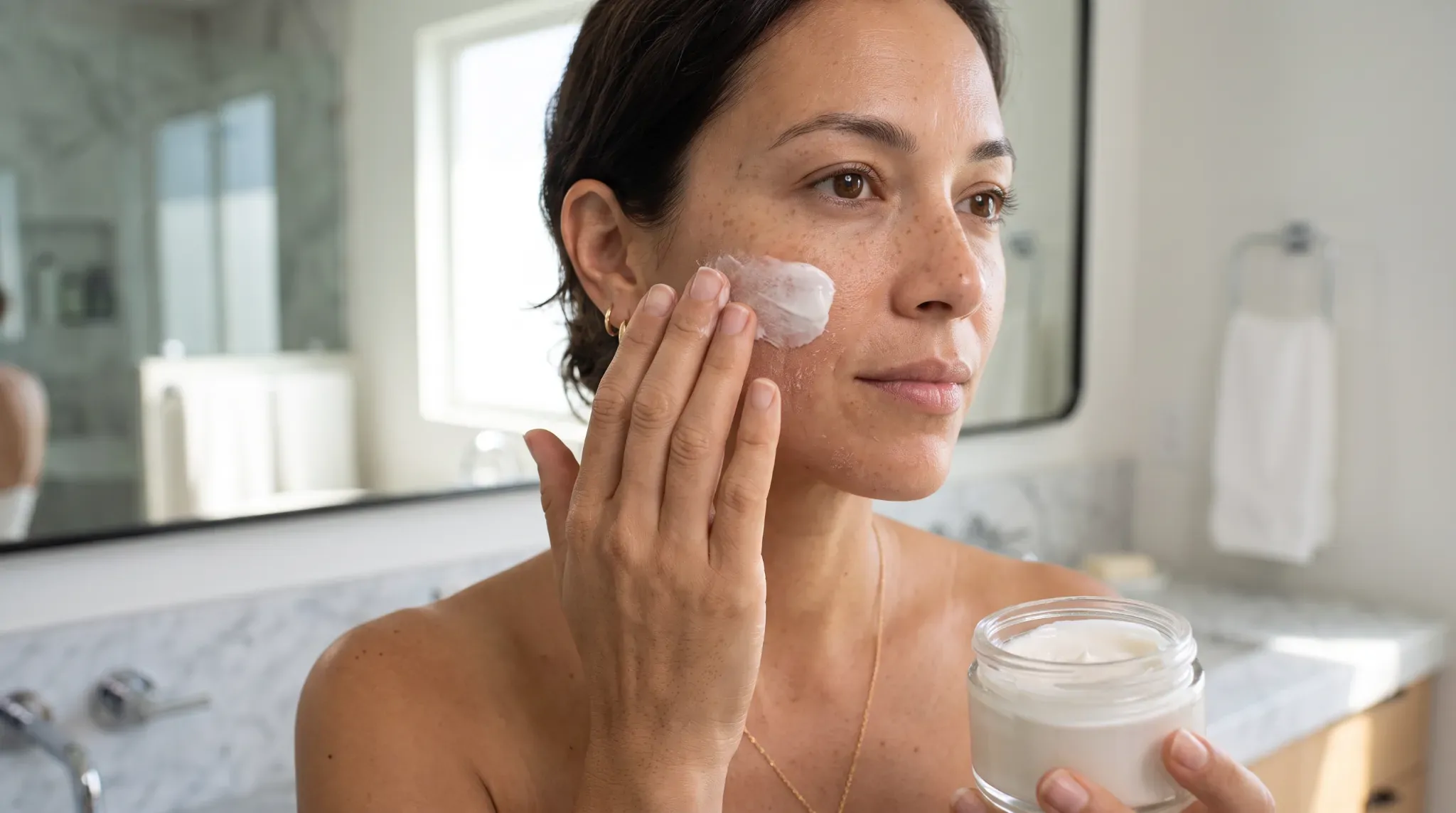
- Stop the actives: Continuing to apply retinoids over raw, peeling skin will only worsen retinol dermatitis.
- Hydrate and occlude: Use a heavy ceramide cream or cica balm to act as an artificial barrier while your skin recovers.
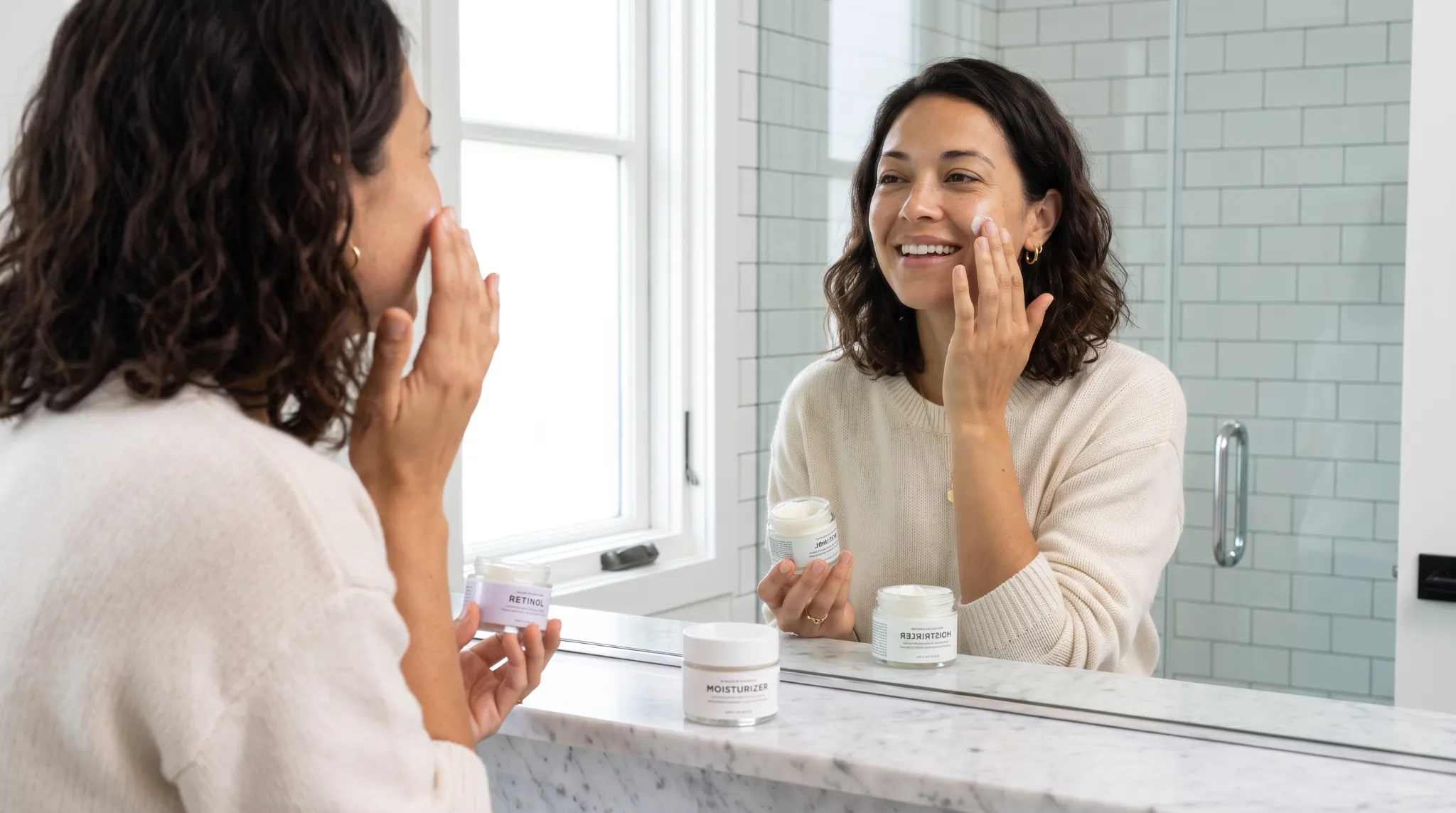
- Buffer your application: When you resume, apply moisturizer before and after your retinol to slow absorption.
- Listen to the sting: If your gentle daily moisturizer suddenly burns, your barrier is severely compromised.
- Protect with sunscreen: Retinoids leave skin more sensitive to UV light, so daily broad-spectrum SPF matters during recovery.
Retinol Skin Peeling vs. a Normal Purge
It is common to have a mild adjustment period when you start vitamin A derivatives. However, a normal “purge” and retinol burn are not the same thing.
A purge speeds up breakouts in the areas where you already get acne. Trapped sebum rises to the surface, so you see small whiteheads and pustules. Severe retinol skin peeling with redness, tightness, and stinging is different. This is retinol dermatitis, a direct chemical irritation. It strips away the lipid mortar that holds your skin cells together.
The table below separates the two reactions, plus the less common allergic response that can look similar.
| Signal | Normal purge | Retinol burn (irritation) | Allergic reaction |
|---|---|---|---|
| Typical onset | Weeks 2 to 6 of use | Days after starting or increasing | Hours to 2 days after contact |
| Where it shows | Only your usual breakout zones | Everywhere the product touched | Can spread past the applied area |
| What it looks like | Whiteheads and small pustules | Red, tight, flaky, shiny skin | Raised, itchy, sometimes weepy rash |
| How it feels | Like a normal breakout | Stings or burns, even with water | Intensely itchy or swollen |
| What to do | Keep going, moisturize well | Stop actives, repair the barrier | Stop and seek medical advice |
- Products that usually feel soothing suddenly sting or burn on contact.
- Skin looks shiny or “plastic-like” despite feeling tight and dry.
- Flaking occurs in large, red patches rather than mild, invisible shedding.
- Even lukewarm water feels prickly or hot on the face.
Why Skin Peeling from Retinol Happens
Retinoids bind to retinoic acid receptors in the skin. This speeds up how fast skin cells divide and shed. In a healthy routine, that reveals fresher skin and supports collagen.

Problems start when you apply the product too often, at too high a strength, or on damp skin. The retinoid then forces the outer layer to shed faster than the skin can build new protective lipids. Those lipids are ceramides, cholesterol, and fatty acids.
Ceramides make up a large share of that barrier. A drop in ceramide content in the outer skin layer is linked to dry, barrier-disrupted skin (Journal of Dermatology, 2021). Without enough lipids, water escapes quickly. This is transepidermal water loss (TEWL), the steady leak of moisture through the skin. The result is raw, retinol flaky skin.
The Lipid Mortar, in Plain Terms
Picture your skin cells as bricks. The lipids between them are the mortar. Each piece has a job, and each one can run low.
| Barrier part | What it does | Sign it is low |
|---|---|---|
| Ceramides | Seal water in and block irritants out | Dryness, flaking, a tight feeling |
| Cholesterol | Keeps the lipid layers flexible | Skin that cracks easily |
| Free fatty acids | Help the barrier stay acidic and calm | Redness and sensitivity |
| Natural moisturizing factor | Holds water inside the top layer | Dull, rough surface |
| Sebum | Adds a light, natural seal | Dry patches next to oily zones |
A healthy barrier keeps these lipids in a set ratio, often described as roughly three parts ceramides to one part cholesterol to one part fatty acids. Retinol burn knocks that balance out of step.
The Best Moisturizer for Retinol Recovery
To stop the skin peeling from retinol, you need to replace the lipids you stripped away. This is not the time for lightweight gel lotions.
The best moisturizer for retinol recovery pairs a high ratio of ceramides with soothing agents and an occlusive. Look for ceramides to rebuild the mortar between cells. Add panthenol (vitamin B5) or centella asiatica to calm redness. Finish with dimethicone or petrolatum to seal in water. If you are unsure whether to reach for a cream or a heavier ointment, our guide to skin protectant cream explains when each format fits.
Which Ingredient Does What
| Ingredient | Main job | Best for |
|---|---|---|
| Ceramides | Rebuild the lipid mortar | The core of any repair cream |
| Cholesterol | Balance the lipid mix | Cracked, very dry skin |
| Panthenol (B5) | Soothe and reduce redness | Stinging, reactive skin |
| Centella asiatica (cica) | Calm visible irritation | Red, hot patches |
| Squalane | Light emollient that softens | Flaking without heaviness |
| Hyaluronic acid | Draw water into the top layer | Dehydration on top of dryness |
| Colloidal oatmeal | Reduce itch and discomfort | Itchy, irritated patches |
| Petrolatum or dimethicone | Seal water in (occlusive) | Raw, very dry areas overnight |
How to Apply It
- Apply to slightly damp skin, within a minute of cleansing.
- Press and pat the cream in. Do not rub or drag the skin.
- Reapply a thin layer at midday if the skin feels tight.
- Use a plain occlusive like petrolatum on the rawest patches at night.
We have compiled a complete list of the exact ceramide creams, cica balms, and gentle cleansers required to fix this issue in our primary guide.
Read the Full Protocol: The 3-Step Skincare Routine for a Damaged Skin Barrier
What to Stop Using While Your Barrier Recovers
Treat this as a short pause, not a permanent ban. The goal is to remove anything that keeps irritating the skin while it rebuilds.
| Pause this | Why | When to bring it back |
|---|---|---|
| AHAs and BHAs (glycolic, lactic, salicylic) | They exfoliate skin that is already shedding | After 2 weeks of calm skin |
| Vitamin C (L-ascorbic acid) | Low pH can sting compromised skin | Once stinging stops |
| Benzoyl peroxide | Drying and irritating on a weak barrier | Only if a doctor advises it |
| Scrubs and cleansing brushes | Physical friction tears the surface | After full recovery |
| Foaming or soap-based cleansers | They strip the lipids you are trying to rebuild | Switch to a cream cleanser for good |
| Fragrance and essential oils | Common triggers for stinging and redness | Reintroduce one product at a time |
| Alcohol denat. | Adds to dryness and tightness | Avoid on the face long term |
| Hot water and long showers | Heat strips lipids and worsens flushing | Use lukewarm water throughout |
Keep using a gentle non-foaming cleanser, a ceramide cream, and a mineral sunscreen. Those three carry the recovery.
A Barrier Repair Routine for Morning and Night
Keep it short. Four steps a day is plenty while your skin recovers, and fewer products mean fewer chances to sting.
Morning
- Rinse with lukewarm water. Skip the cleanser if your skin feels raw.
- Apply a ceramide barrier cream to damp skin.
- Finish with a broad-spectrum mineral sunscreen of SPF 30 or higher.
Night
- Cleanse with a gentle cream or non-foaming cleanser.
- Apply a barrier repair serum if your skin tolerates it.
- Seal with a thick ceramide cream.
- Add a thin layer of petrolatum to the rawest patches.
Does Buffering Weaken Your Retinol?
Many readers worry that moisturizing first cancels out the retinol. The evidence so far says it does not. In a 2025 review reported by Dermatology Times, an “open sandwich” routine, where moisturizer goes on before the retinoid, did not reduce retinoid activity. Buffering slows absorption, so it is a fair trade rather than a wasted step.
How Long Does Retinol Skin Peeling Last?
Most mild irritation settles within two to four weeks once you stop the active. Symptoms often peak between day 8 and day 21. A badly damaged barrier can take longer, and the pace depends on how strong the product was and how often you used it.
| Phase | What you may notice | What to do |
|---|---|---|
| Days 0 to 3 | Stinging, redness, tightness | Stop actives, cleanse with water only |
| Days 4 to 10 | Visible flaking and rough patches | Ceramide cream morning and night |
| Days 11 to 21 | Peeling slows, redness fades | Keep the routine boring and steady |
| Weeks 3 to 4 | Skin feels calm and comfortable | Reintroduce the retinoid slowly |
| After week 4 | No stinging with basic products | Resume the sandwich method |
Why Some People Peel More Than Others
Two people can use the same retinol and have very different reactions. Several factors raise the odds of peeling:
- A higher strength, or a jump from one strength to the next.
- Applying more than a pea-sized amount, or using it every night from the start.
- Applying to damp skin, which pushes the active in faster.
- Layering it with acids, vitamin C, or benzoyl peroxide on the same night.
- Dry or cold weather, which lowers the skin’s natural oil levels.
- Starting with an already weakened barrier, such as after illness or sunburn.
If you peeled badly once, you are not doomed to repeat it. Lower the strength, space out the nights, and buffer with moisturizer. Your skin often adapts over several weeks.
If the peeling has not eased after four weeks of gentle care, or if it keeps returning, get a professional opinion.
When Retinol Burn Needs a Doctor
Most retinol burn settles with rest and moisturizer. A few signs mean the reaction is beyond home care.
- The rash spreads well beyond the area where you applied the product.
- The skin is oozing, weeping, or forming blisters.
- There is swelling around the eyes, lips, or mouth.
- You see yellow crusting, warmth, or increasing pain, which can point to infection.
- You have a fever along with the skin reaction.
- Nothing improves after two weeks of careful, gentle care.
A skin doctor can tell whether you are dealing with simple irritation, an allergy, or an infection. Each one needs a different plan. Before you restart any new product, patch test it on your inner forearm for a few days.
Mistakes That Slow Down Barrier Recovery
Small habits can stretch a two-week recovery into a month. Most setbacks come from doing a little too much, a little too soon.
| Mistake | Why it backfires | Do this instead |
|---|---|---|
| Foaming cleanser twice a day | It strips the lipids you are trying to rebuild | Rinse with water in the morning |
| Adding several new products | You cannot tell which one stings | Change one product at a time |
| Scrubbing away the flakes | Friction damages skin that is already shedding | Let cream soften the flakes |
| Skipping sunscreen | Retinoid skin burns more easily in the sun | Wear mineral SPF 30 or higher daily |
| Restarting retinol too soon | If it still stings, the barrier is not ready | Wait until basic cream feels neutral |
| Using hot water | Heat strips lipids and worsens redness | Keep water lukewarm |
The fastest route back is the dullest one: a gentle cleanser, the best moisturizer for retinol recovery rich in ceramides, sunscreen, and time. When managing retinol peeling skin, resist the urge to test your skin with an active every few days. If you notice persistent peeling skin from retinol, each premature application restarts the inflammatory clock.
Prevention: How to Reintroduce Actives
Once your barrier has recovered, usually after 14 to 28 days of strict hydration, you can carefully bring your retinoid back. To prevent another retinol dermatitis flare, use the “Sandwich Method”:

- Cleanse and apply a light layer of ceramide moisturizer to damp skin.
- Wait 10 full minutes for the skin to dry. Water pulls retinoids deeper and adds to irritation.
- Apply a pea-sized amount of retinol.
- Apply a final, heavier layer of barrier repair cream.
Start with the lowest strength you can find, once or twice a week. Add one extra night only after your skin stays calm for a full week. Slow and steady beats fast and flaky.
Choose a Gentler Retinoid
Not all vitamin A products bite equally. Retinal, also called retinaldehyde, needs one conversion step in the skin to become active. Retinol needs two, so it tends to act more slowly and gently. Encapsulated retinol releases over time, which can also soften the shock to a sensitive barrier.
Frequently Asked Questions
Can you use retinol and hyaluronic acid together?
Yes, you can safely use retinol and hyaluronic acid together. Hyaluronic acid is a humectant that draws moisture into the skin. It counteracts the dryness and tightness caused by retinol. Apply hyaluronic acid to damp skin, let it absorb, and then apply retinol.
When should you start using retinol?
Dermatologists often recommend introducing retinol in your mid-to-late twenties. Natural collagen synthesis and epidermal cell renewal begin slowing during this decade. If you treat stubborn acne or post-blemish discoloration, your dermatologist may suggest starting earlier.
What does retinol purging look like?
Retinol purging looks like small whiteheads and mild papules in zones where you normally break out. It stems from accelerated cellular turnover. Purging does not cause burning pain, intense facial redness, or widespread peeling sheets of skin.
Can you use niacinamide and retinol together?
Yes, niacinamide and retinol work exceptionally well together. Niacinamide (vitamin B3) reinforces the stratum corneum barrier and boosts natural ceramide production. This calming action helps skin tolerate retinoid therapy with less flaking and redness.
Can you mix retinol and hyaluronic acid?
You can layer both products during your evening routine. Rather than mixing them together in your palm, apply hyaluronic acid first to damp skin. Allow your face to dry completely before applying retinol, as damp skin speeds penetration and triggers irritation.
What is a retinol peel?
A retinol peel is an in-office chemical peel administered by a medical professional or aesthetician. It uses high-potency retinoid formulations to exfoliate surface layers. It causes controlled peeling for several days and requires intensive barrier repair afterward.
Sources & Methodology
Every claim in this guide maps to published dermatology research or clinical consensus. We do not use marketing statistics or brand-sponsored numbers.
- Mukherjee S, Date A, Patravale V, Korting HC, Roeder A, Weindl G (2006). “Retinoids in the treatment of skin aging: an overview of clinical efficacy and safety.” Clinical Interventions in Aging 1(4):327-348.
- Zasada M, Budzisz E (2019). “Retinoids: active molecules influencing skin structure formation in cosmetic and dermatological treatments.” Postepy Dermatologii i Alergologii 36(4):392-397.
- Journal of the American Academy of Dermatology (2024). “Mitigation of retinol-induced skin irritation by physiologic lipids: evidence from patch testing.” Physiologic lipids eased retinol discomfort; 3% niacinamide did not.
- American Academy of Dermatology (AAD). Clinical guidance on starting topical retinoids slowly, moisturizing with ceramides, and applying daily broad-spectrum photoprotection.